Report

Two Years of Turmoil: The Strategic Evolution of Anti-Israel Activism on U.S. Campuses and 2025–2026 Challenges

Columbia students organize memorials and rallies on the first anniversary of Hamas's October 7, 2023, terror attack, on October 7, 2024, in New York City. Anti-Israel protesters hold "Victory of the Resistance" signs, a slogan that references Palestinian terror groups, including Hamas

(Alex Kent/Getty Images)

Columbia students organize memorials and rallies on the first anniversary of Hamas's October 7, 2023, terror attack, in New York City. Anti-Israel protesters hold 'Victory of the Resistance' signs, a slogan that references Palestinian terror groups, including Hamas. 

For the past two years, college and university campuses across the U.S. have become hotbeds of antisemitism and intense anti-Israel activism.

As the 2025–2026 academic year progresses, the issue remains a central concern and an evolving challenge that universities must proactively address to ensure a safe, inclusive environment for all members of campus communities.

Despite new policies and enforcement efforts that have curbed some anti-Israel campus activity, the core problems persist, including the targeting of Jewish organizations, the normalization of support for terror, and the intimidation and harassment of Jewish, Israeli, or Zionist individuals and anyone deemed supportive of Zionism.

The opening weeks of the fall semester, punctuated by the October 2025 ceasefire deal between Israel and Hamas, already signal a continued strategic pivot in the anti-Israel student movement. Leading groups, including Students for Justice in Palestine (SJP) and Jewish Voice for Peace (JVP), are adapting their tactics to the changing political landscape and administrative scrutiny.

This shift moves away from highly visible initiatives like the tent encampments of 2024 and toward more calculated tactics focused on internal pressure and disciplinary evasion. These tactics include the creation of coercive campus environments pushing anti-Israel agendas, mobilization against university officials and administrations, the normalization of extreme advocacy through faculty-driven organizing, and shadow boycotts.

This ADL analysis examines how key trends in U.S. anti-Israel campus activity have formed since October 7, 2023, breaks down current shifts, and provides recommendations for universities to respond proactively to changing tactics and potential attempts to evade accountability.

Tactical Evasion: From High-Profile Encampments to Calculated Disruptions

The current climate on U.S. campuses is a direct result of the massive shift that began during the 2023–2024 academic year. Campus life was fundamentally altered for many starting weeks into the school year when Hamas’s October 7, 2023, terror attacks in Israel triggered a record volume of anti-Israel activity. The attacks also led to the emergence of notable trends and strategies that have contributed to an unprecedented surge in explicitly antisemitic incidents on campuses.

The year culminated in the high-profile encampments and “direct actions” of the 2024 spring semester, amid on- and off-campus calls for escalation that stretched into the summer. The more extreme incidents during this period included violent takeovers of spaces, property damage, physical assault, targeted harassment, and vandalism. Some incidents were marked by blatant acts of antisemitism.

As calls for accountability mounted, many university administrators responded by implementing new time, place, and manner rules, non-discrimination policies and student codes of conduct for the 2024–2025 academic year. These updates generally placed firmer restrictions on location and timing, clarified disciplinary actions for disruptions, and specifically prohibited overnight encampments.

These policies significantly impacted the previous strategy. While encampments did reappear in the 2024-2025 school year, they were far less prevalent: approximately a dozen campuses hosted encampments in 2024-2025 compared to over 160 in the 2023-2024 school year. Those that were set up were often quickly disbanded.

Nationwide, the tactics evolved as many student groups traded the tents and escalation acts for more sustainable strategies designed to disrupt operations while sidestepping updated campus policies related to conduct and discipline.

These have included quieter sit-ins and study-ins, often in campus libraries, as well as targeted disruptions of key campus events such as career fairs, new student orientations, and commencements. Anti-Israel activism has also focused on hunger strikes by students and faculty, who took such action at more than half a dozen schools and school systems in 2024-2025.

These trends continue into the 2025-2026 school year, with hunger strikes already recorded at multiple schools since the start of the fall semester.

Undeterred: Student Groups Continue to Drive Anti-Israel Activism

Since October 7, 2023, over 50 student groups have been banned, temporarily suspended, or otherwise reprimanded across dozens of U.S. campuses as administrations cracked down on violations of preexisting or updated conduct policies. 

Far from achieving deterrence, these disciplinary measures spurred some organizational evasion and rebranding. Some censured groups shed their university affiliation, dropping the school's name or logo or explicitly stating their non-affiliation on social media. Others voluntarily disaffiliated following prior suspensions or in anticipation of action.

Crucially, students at numerous universities simply continued to engage in extreme anti-Israel activities regardless of group or affiliation.

In some cases, suspensions contributed to an embrace of more aggressive groups, tactics, and rhetoric. This shift reflects a broader trend since October 7, 2023, where segments of the anti-Israel movement have become increasingly disillusioned with organizations perceived as too moderate.

The 2023 suspensions of Columbia University’s SJP and JVP chapters breathed new life into Columbia University Apartheid Divest (CUAD), an aggressive anti-Israel coalition group made up of dozens of student organizations. It was first established in 2016 and had been largely dormant since 2020 until its revival in October 2023. CUAD has been credited with “sparking the international student intifada of encampments and occupations” by a splinter group called Columbia Palestine Solidarity Coalition that has taken even more hostile positions.

Some students pushed their SJP or JVP chapters toward extreme positions or abandoned them entirely to form or join new groups. For example, in September 2025, several former Jewish Voice for Peace (JVP) chapters announced their disaffiliation from the national organization and the formation of a new, more radical student group named the Anti-Zionist Jewish Student Front (AJSF). It claims to be seeking “divestment from Zionism and full liberation in Palestine, from the river to the sea,” and implicitly criticizes JVP’s rhetoric regarding Zionism and Judaism.

Founding chapters of AJSF replaced former JVP chapters at American University, Georgetown University and George Washington University (which had faced multiple rounds of disciplinary actions, including a suspension set to last for at least the 2025-2026 school year).  AJSF joins the ranks of groups like Judaism On Our Own Terms (JOOOT) and Jews Against White Supremacy (JAWS) in breaking from the longstanding positions of established organizations like JVP.

A Hostile Environment: Targeting Jewish and Israeli Campus Life

The systematic targeting of Jewish life on campus, documented in detail by ADL, remains a major area of concern as the 2025–2026 school year progresses, sustaining a hostile trend that persisted throughout the past two academic years.

Since October 7, 2023, Jewish campus organizations, including Hillel and Chabad, which provide vital community support, have been targeted on numerous occasions. These include nearly 200 incidents of antisemitic harassment and vandalism between October 2023 and October 2025, according to an ADL tally, as well as social media posts and other campaigns calling for their removal over real or perceived Zionism. Protest slogans like “We don’t want no Zionists here,” “Zionists off our campus,” and “Zionism is Nazism” at universities have demonized and vilified Zionists, and featured calls to destroy Zionism.

Simultaneously, individual Jewish and Israeli students, faculty, staff, and speakers have faced significant hostility and endured calls for expulsion, exclusion, boycott, and violence.

Notable examples of this trend:

  • Rice University (October 2025): Rice University SJP threatened to walk out of a talk hosted by Rice University's Baker Institute, featuring former Israeli hostage Omer Shem Tov. SJP in the event flier claimed, “Our campus can’t be overtaken by Zionist brainwashing.” In a statement explaining why it didn’t go through with the walkout, the group claimed the protest was meant to “protest Rice’s decision to legitimize a genocide and occupation by platforming an Israeli hostage narrative without any Palestinian perspectives.”
  • Princeton University (April 2025): Protesters targeted a talk by former Israeli prime minister Naftali Bennett, directing insults at Jewish attendees, calling them “inbred swine,” telling some to “go back to Europe,” and causing the event to end prematurely by pulling a fire alarm.
  • Baruch College (September 2024): An event organized by the Hillel chapter at
    Baruch College for first-year Jewish students at a kosher restaurant in New York City was assailed by activists with the college’s SJP chapter, who chanted the name of Baruch Hillel’s executive director, accusing the individual of “committing genocide” outside the eatery. They further harassed students, threatened violence, and taunted them about executed Israeli hostages.
  • Temple University (August 2024): An anti-Israel protest organized by SJP targeted the Hillel building, with participants marching across campus while chanting, “Intifada, Intifada; Long Live the Intifada,” a slogan commonly used as a call for violence against Israel and possibly against the Jewish community. Protesters also displayed the flag of the antisemitic U.S.-designated terror group Popular Front for the Liberation of Palestine (PFLP).
Photo: An Instagram story from Temple SJP in front of the Temple Hillel building.

An Instagram story from Temple SJP in front of the Temple Hillel building, featuring a PFLP flag. (Screenshot/Instagram) 


The campus environment surrounding the first and second anniversaries of the Hamas attack were particularly fraught, as anti-Israel protesters – some of whom openly celebrated the deadliest day for Jews since the Holocaust – routinely disrupted events organized or attended by Jewish and Israeli students to commemorate October 7 victims, and staged walkouts and protests that also featured overt support for the attack itself, Hamas, and other groups. 

Glorifying Violence: The Open Embrace of Pro-Terror Rhetoric in Student Activism

Solidifying a pre-October 7 trend, some anti-Israel student groups brazenly continue to embrace extreme anti-Zionist rhetoric and express unwavering solidarity with terror groups, their leaders, and general violence.

Campus events by anti-Israel activists over the past two years have featured flags, logos, images, and other visual signifiers associated with U.S.-designated terror groups like Hamas, Hezbollah, and the PFLP. Slogans and chants at events, such as “Al-Qassam, make us proud, kill another soldier now,” have openly venerated Hamas’s military wing and other affiliates.

Student groups have defended or backed the October 7, 2023, attacks in widely shared statements. And vandalism incidents in this period have often included imagery of the inverted red triangle, which, since October 7, has frequently been used to glorify Hamas violence against Israel and Zionists.

These examples underscore this development:

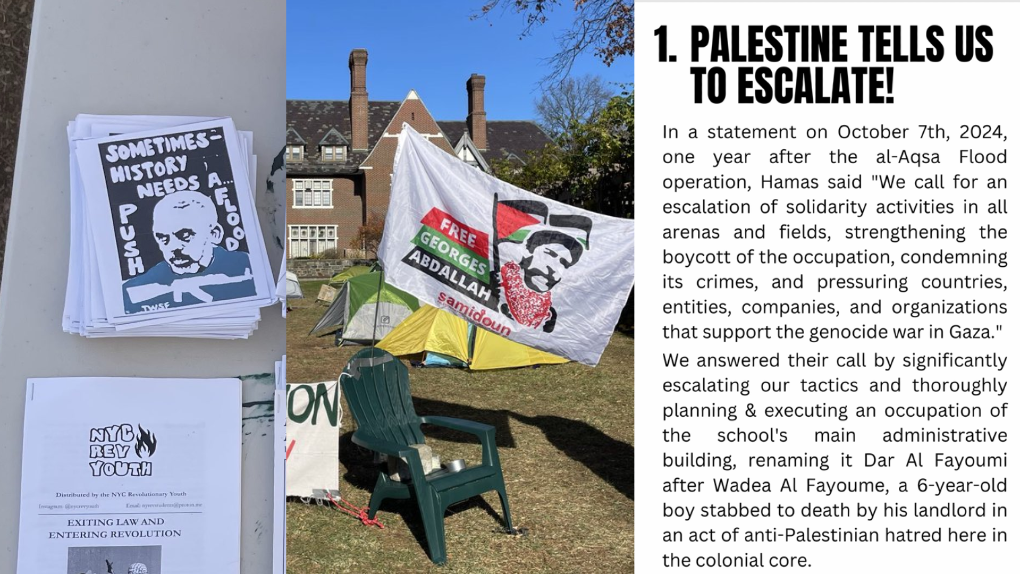
  • Sarah Lawrence College: Students held a fall 2024 encampment where they distributed printed zines glorifying Hamas’s Yahya Sinwar, the architect of the October 7 attacks. They also prominently displayed a “Free Georges Abdallah” banner. Abdallah is the notorious terrorist convicted for his involvement in the 1982 murders in Paris of an Israeli diplomat and an American military attaché. The banner was branded with the logo of the government-sanctioned, PFLP-tied “sham charity” Samidoun. In a zine published after the encampment, the Sarah Lawrence activists wrote they had “answered [Hamas’s] call by significantly escalating our tactics.”

    Photo: Items from the Sarah Lawrence College encampment.

    Items from the Sarah Lawrence College encampment: Yahya Sinwar propaganda, a Samidoun flag featuring convicted murderer Georges Abdallah, and a zine produced after the encampment by “anonymous students.” (Screenshots/X and website)  


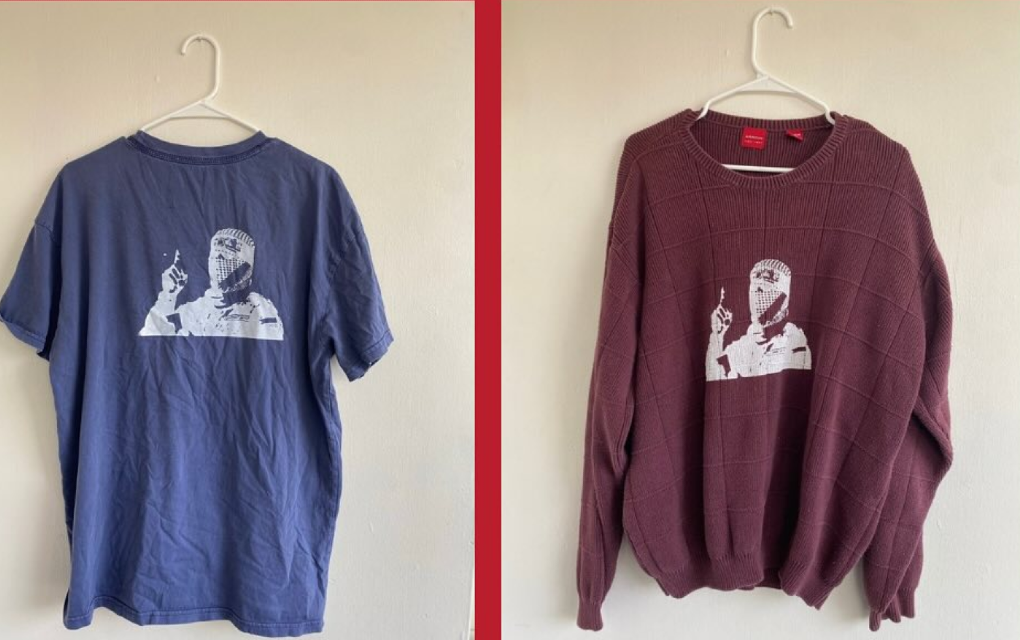
  • University of Washington (UW): In April 2025, the SJP-affiliated student group SUPER UW (Students United for Palestinian Equality & Return) at the University of Washington sold sweaters and T-shirts that featured images of Hamas spokesperson Abu Obaida to fundraise for their activities, despite being suspended by the university. Later that month, SUPER UW hosted Mohamad Khatib, the European coordinator for Samidoun, via video conference.

    Photo: Clothing featuring former Hamas spokesperson Abu Obaida sold by SUPER UW.

    Clothing sold by SUPER UW featuring former Hamas spokesperson Abu Obaida. (Screenshot/Instagram) 


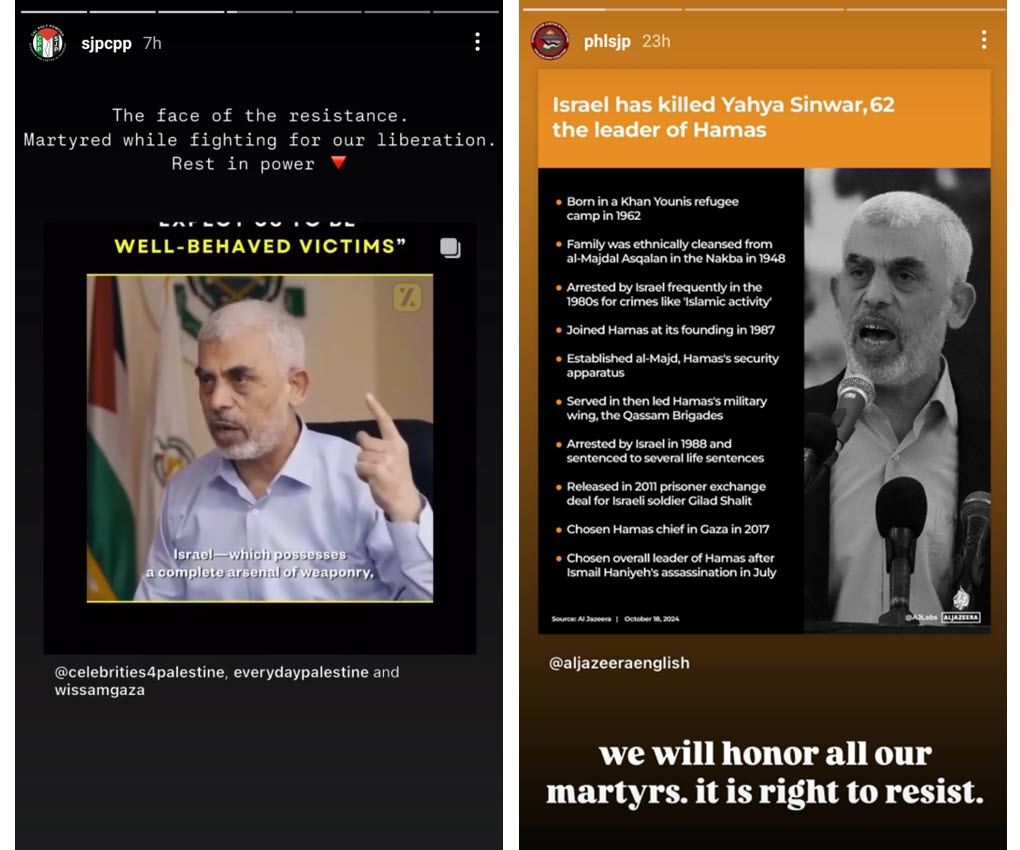
On the occasions of the 2024 and 2025 anniversaries of Hamas’s October 7 attacks, student groups reaffirmed their support for Hamas and glorified the terror group both online and on the ground. This open and repeated praise of terror groups and their leaders is a year-round constant on social media.

Photo: Examples of social media posts published by anti-Israel student groups.

Examples of social media posts published by anti-Israel student groups at U.S. colleges memorializing Hamas leader Yahya Sinwar in the hours after his death was announced. (Instagram) 


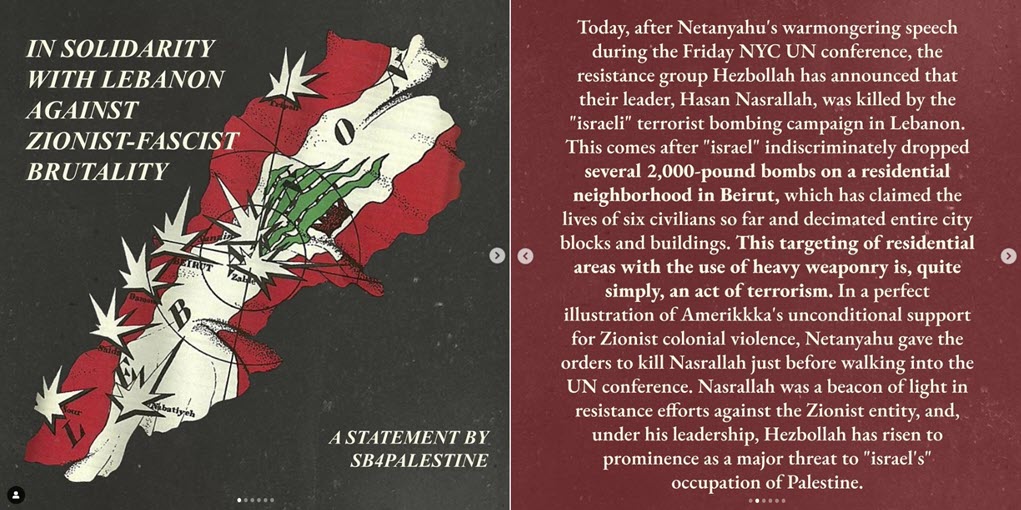
Photo: A statement published by anti-Zionist student groups at Stony Brook University in Stony Brook, NY.

A statement published by anti-Zionist student groups at Stony Brook University in Stony Brook, NY, in remembrance of Hezbollah leader Hassan Nasrallah after his death on September 27, 2024. (Instagram) 


Mobilization against University Leadership: Administrators, Boards of Trustees Face Harassment, Vandalism

Over the past two years, university officials and administrators at schools across the country have repeatedly been targeted with protests, vandalism, and harassment at their residences, workplaces, and online.

These targeted, confrontational tactics are expected to be at the forefront of anti-Israel student organizing as the 2025–2026 school year continues.

Notable incidents of this approach included the June 2025 vandalism of the homes of at least four University of Wisconsin Board of Regents with graffiti reading, ”UW blood on your hands” and ”Regents are complicit in Palestinian genocide”; the November 2024 vandalism of the home and personal vehicle, of University of Washington President Ana Mari Cauce; and the December 2024 vandalism of the home of University of Michigan Regent Jordan Acker, who is Jewish. The last two instances featured extensive property damage and use of inverted red triangle graffiti.

This strategic focus on university leadership appears to have been formalized in late August 2025 when National Students for Justice in Palestine (NSJP) and Writers Against the War on Gaza (WAWOG) published a joint issue urging members and supporters to specifically target Boards of Trustees, using the phrase “Board of Butchers.”

“In order for us to remove the imperial university as a roadblock to the struggle for Palestinian liberation, we must dismantle its structure—starting with these Boards of Butchers,” NSJP wrote, reflecting on the student movement since October 7 and strategies for the new school year.

In the first few weeks of the fall 2025 semester, numerous SJP chapters adopted this messaging, sharing their own “Board of Butchers” posts on social media and on the ground. They held protests targeting trustees and plastering the names and photographs of individual board members on fliers and placards around campus.

These activities spiked around the second anniversary of October 7, in connection with an NSJP-led “Week of Rage.”

Shadow Boycotts and Financial Coercion: The Evolving BDS Strategy

While the overall volume of Boycott, Divestment, and Sanctions (BDS) resolutions and referenda across undergraduate, graduate, and professional student and staff unions dropped in the 2024–2025 school year (39 voted on, down from 86 voted on in 2023–2024), this period introduced a critical new tactic: student governments sought to force institutional action by focusing resolutions specifically on restricting how student activity fees could be used.

Examples of this financial pressure:

  • University of Michigan and The New School: Student governments sought to halt funding for student clubs until their institutions divested from companies linked to Israel. At the University of Michigan, the Shut It Down party shut the student government down, vetoing the spring/summer and fall budgets, stopping all funding and demanding divestment from investments associated with Israel. At The New School, the student senate voted to freeze club funding in August 2024 until divestment was achieved. In both cases, university administrations were forced to intervene to provide necessary funding. (The student body leadership at the University of Michigan was later impeached.)
  • UC Davis Law School: Administrators swiftly suspended the UCD Law School Student Association after it passed a divestment resolution barring the use of funds for companies and speakers “complicit in the occupation and genocide in Palestine.” The administration also demanded that the law school take control of managing student fees while the group was suspended. Following the repeal of the BDS amendment, the student association was reinstated on campus.

The student governments at the University of California, Santa Barbara, and the University of California Law, San Francisco passed resolutions attempting to codify this tactic.

This financial trend is already continuing in 2025–2026, as efforts to enforce the academic and cultural boycott intensify despite the ceasefire.

Simultaneously, on campuses and within professional academic associations, BDS activism is increasingly expanding into “soft” or “shadow” boycotts, operating through omission and quiet pressure rather than formal resolutions.

This strategy is proving effective: In ADL/AEN’s spring 2025 survey of 209 Jewish-identifying faculty, half of the respondents surveyed reported that their campuses had been affected by such boycotts, most often through departments avoiding co-sponsorship with Jewish or pro-Israel groups (55.2%) or discouraging partnerships with Israeli institutions and academics (29.5%).

This shift to quiet pressure is increasingly reflected in active student life. For example, student government resolutions, such as the one at Michigan State University, have called on the university to cancel events hosted by Israelis who previously served as Israel Defense Forces (IDF) soldiers. Given Israel’s mandatory military service for most citizens, this policy would effectively exclude much of the Israeli population from campus events.

This tactic is also visible in high-profile cases, such as the August 2025 allegation that the University of Oregon Law Review rejected an Israeli professor’s article solely on the basis of his nationality.

In November 2025, in a broader pattern of protesting the presence of former IDF soldiers discussing their experiences in Gaza and Israel, the University of Maryland Student Government Association passed two resolutions: one demanding a formal apology to detained students who protested an October 2025 event where Israeli soldiers were speaking, and another urging the university to condemn the event and to alter university policy to ensure that students and academics bar speakers "who have been found, or are being actively investigated for genocide, war crimes, crimes against humanity or systematic human rights violations.”

At the beginning of the 2025–2026 academic year, groups like the University of Maryland SJP circulated “boycott” lists to pressure students into adhering to strict ideas about appropriate interactions with “Zionists” or those individuals or businesses even vaguely perceived to be Zionist. Underscoring the hostility, the University of Maryland Student Government Association passed a BDS resolution in October 2025, scheduling the vote on the Jewish holiday of Yom Kippur, a timing that drew strong condemnation from Jewish campus leaders.

Similar boycott recommendations have also been posted by the Northeastern University School of Law.

Institutional Cover: The Expansion of Anti-Israel Faculty and Staff Networks

Faculty- and staff-led organizing is poised to become a defining driver of the campus environment in 2025–2026. Over the past school year (2024-2025), faculty-led networks such as Faculty and Staff for Justice in Palestine (FSJP) have expanded rapidly, with more than 130 affiliated groups now established nationwide.

Many FSJP chapters and members have openly justified violence and terror attacks against Israel, and, in multiple cases, they have employed antisemitic imagery or rhetoric. Data from the 2025 ADL/AEN survey revealed that nearly three-quarters of the respondents had observed anti-Jewish activity originating from other faculty, staff, or administrators.

At several campuses, faculty have already used their positions to mainstream extreme and misinformed rhetoric, presenting it as part of academic discourse rather than activism.

The role of faculty and staff in encouraging and participating in extreme anti-Israel activities has already made its mark in the early days of the 2025-2026 school year.

  • In August 2025, a visiting scholar at Syracuse University, Mosab Abu Toha, spoke on a panel at the second annual People’s Conference for Palestine in Detroit, Michigan. He expressed reverence for the late PFLP terrorist Walid Daqqa and PFLP spokesperson Ghassan Kanafani and described Israelis as “thieves,” “child killers,” and “sexual abusers.”
  • In September 2025, at the 45th annual ArabCon in Dearborn, Michigan, San Francisco State University (SFSU) professor Rabab Abdulhadi refused to condemn Hamas’s October 7 attack, stating, "I never, ever condemn Palestinian resistance and anyone[’s] resistance around the world." Abdulhadi, who is known for her long history of extreme anti-Israel and pro-terror views that frequently cross the line into antisemitism, characterized Hamas’s actions as the “liberation of prisoners” and cast doubt on the death toll of the attacks. Abdulhadi is the founding director of SFSU’s Arab and Muslim Ethnicities and Diasporas (AMED) Studies Program and a member of FSJP and the Institute for the Critical Study of Zionism (ICSZ).

This blending of scholarship and advocacy will likely intensify as the school year progresses, lending institutional cover to student groups while making antisemitic narratives significantly harder to challenge within the university setting.

Conclusion & Recommendations: The Imperative for Institutional Resolve

As the 2025–2026 school year progresses, universities face a dual, evolving challenge. Entrenched anti-Israel networks and movements are poised to adapt with new tactics. Simultaneously, administrators are under growing legal, political, and moral pressure to respond more forcefully, with emerging policies and federal actions offering new tools to curb harassment.

External developments, particularly the Israel–Hamas war and broader relations in the wake of the October 2025 ceasefire deal, will also continue to influence campus dynamics, with potential flare-ups driving surges in unrest.

The policy environment is shifting in ways that will shape the trajectory of campus antisemitism. Federal and state actions — including Title VI enforcement, new restrictions on masked protests, and litigation targeting university inaction — are beginning to have tangible effects. The coming year is likely to bring sharper legal pressure on universities, particularly as high-profile cases advance through the courts. Whether these interventions lead to meaningful change on campus remains uncertain, but they will add another layer of scrutiny to how institutions respond.

Building on these lessons, ADL urges universities to take the following six steps, which remain essential for countering antisemitism on campus:

  1. Speak up forcefully against antisemitism and support Jewish community members.
  2. Promote campus safety by communicating and enforcing rules governing protests and demonstrations and policies prohibiting discrimination.
  3. Establish a Title VI office or coordinator.
  4. Conduct antisemitism trainings and create spaces for civil discourse.
  5. Ensure accountability with regular climate assessments and an antisemitism task force.
  6. Reaffirm faculty professional responsibilities.

The coming year presents both risks and opportunities. If institutions act with clarity and resolve — upholding and enforcing their own rules, protecting vulnerable communities, and rejecting double standards — they can blunt the impact of destructive trends and strengthen the foundations of academic life. Failure to do so will only deepen the divisions and fears that have defined the campus climate nationwide since October 7, 2023.