




(Screenshot/Instagram)
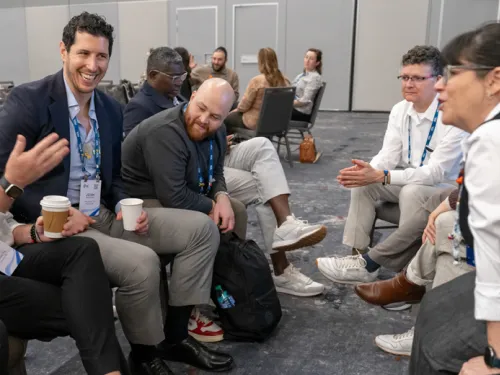
A teach-in led by New York University’s chapter of Faculty and Staff for Justice in Palestine in February 2024.

Key Points
Background
Faculty & Staff for Justice in Palestine (FSJP) is a decentralized national network of anti-Zionist academics and university staff that organizes anti-Israel activities across campuses in the United States. FSJP can refer both to individual campus chapters as well as to their national network (sometimes also referred to as NFSJP). FSJP chapters play a key role in amplifying anti-Zionist activism on college and university campuses, particularly in fueling the efforts of the Boycott, Divestment, and Sanctions (BDS) movement.
Through their authority, tenure protections, and access to administrative channels, FSJP chapters actively support local Students for Justice in Palestine (SJP) chapters and anti-Israel campus unions, amplifying their influence and working to protect them from disciplinary consequences by university administrations.
Although some individual anti-Israel faculty groups began to emerge before the October 7, 2023, attack on Israel, the bulk of the groups that would become local FSJP chapters emerged in the aftermath, in part answering a call by the US Campaign for the Academic and Cultural Boycott of Israel (USACBI) for academics and campus staff nationwide to organize.
In response, academics, professors, and other university employees across the U.S. launched dozens of new local groups that banded together in February 2024 to form the Faculty for Justice in Palestine (FJP) national network—now formally known as Faculty & Staff for Justice in Palestine National Network (NFSJP).
While the network is structurally decentralized, with individual chapters frequently running their own social media accounts and events, NFSJP provides a coordinated central hub, with its own social media, website, and a repository of political educational resources and press releases. This national body also organizes campaigns to dismantle study abroad programs to Israel, push for divestment, and enact academic boycotts. Ahead of the 2024-2025 academic school year, NFSJP declared the lifting of the American Association of University Professors' (AAUP) ban on academic boycotts to be “one of the largest achievements” of the network to date.
As of late January 2025, the National Steering Committee consisted of NFSJP Facilitator Sherene Seikaly (University of California, Santa Barbara), NFSJP Secretary Andrew Ross (New York University), Sophia Azeb (University of California, Santa Cruz), Lara Deeb (Claremont Consortium), Bassam Haddad (George Mason University), Greta LaFleur (Yale University), Nadine Naber (University of Illinois Chicago), and Neferti Tadiar (Barnard College). Public-facing information about the committee’s membership has since been removed from the NFSJP website.
As of mid-2025, affiliated FSJP chapters operate at more than 130 U.S.-based colleges and universities. Some chapters work under alternative names such as Faculty for Justice in Palestine (FJP), Faculty for Palestine, Academics for Justice in Palestine (AJP) and Educators for Justice in Palestine (EJP).
Ideology and Demands
The national FSJP network upholds six “Principles of Unity.” Among these principles are support for SJP; endorsement of BDS, particularly against Israeli academic and cultural institutions; promotion of activities and education supporting the “cause of Palestinian liberation”; and defense of students and other members of campus communities who may face consequences for violations of campus policies during anti-Israel activities. They promote the belief that Israel is a settler-colonial, racist, and apartheid state, and that Israel and Zionism must be understood as part of “interlocking systems of oppression underpinned by global white supremacy and racial capitalism.”
Critically, the network has intensified calls for academic BDS—the boycott of Israeli universities and scholars—seeking to institutionalize policies that sever academic partnerships, discourage research collaboration, and end study-abroad or exchange programs with Israeli institutions.
FSJP chapters often frame their demands as efforts to uphold academic justice, while rejecting claims that such actions may marginalize Jewish or Israeli students and faculty.
Their demands also include granting protections or amnesty for students and faculty engaged in anti-Zionist activism that violates university policies. A few FSJP chapters have joined calls to ban or cut ties with Jewish campus and communal organizations, such as Hillel, citing those organizations’ alleged Zionist positions or activities relating to Israel. Targeting Jewish groups like Hillel, one of the primary campus Jewish life organizations, threatens to marginalize Jewish students and organized Jewish life on campus as a whole.
These efforts are part of a broader strategy to reshape academic discourse and institutional policy around the delegitimization of Israel and the exclusion of Zionism and Zionists.
The impact of FSJP groups is magnified by their members' institutional authority. Members often have tenure, union protections, and influence over their students, which they use to legitimize a biased anti-Israel worldview under the guise of academic critique. This allows them to normalize anti-Israel bias and anti-Zionism in classrooms and official university communications, contributing to a campus environment where Jewish and pro-Israel community members may feel marginalized or intimidated.
Justification of Terror and Attacks on Israel
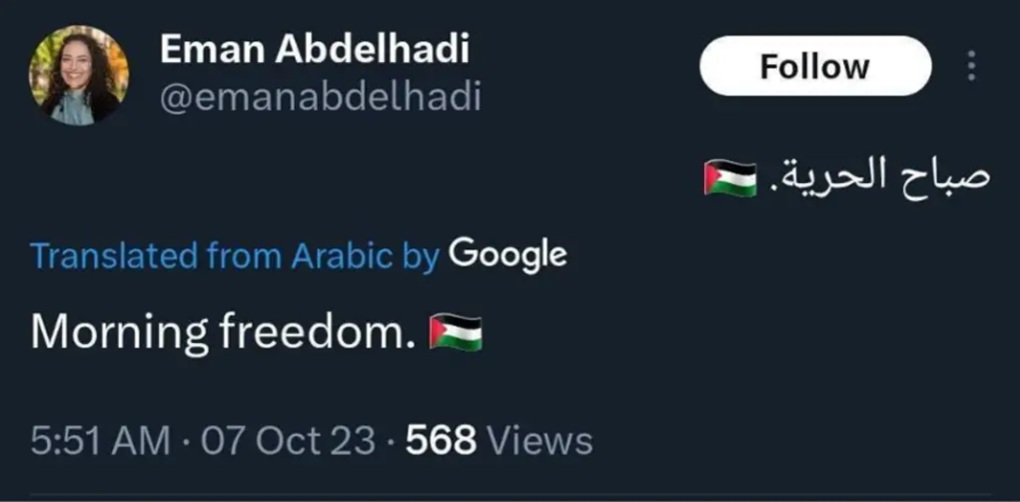
At times, FSJP chapters, members, and speakers at FSJP events have made statements justifying violent terror attacks against Israel. These remarks include attempting to “contextualize” Hamas’s October 7, 2023, terror massacre by shifting blame solely to Israel, as well as rejecting peace or coexistence with Israel. For example:
Sharing of Antisemitic Imagery and Statements
In multiple cases, FSJP members, chapters, and guest speakers have expressed explicitly antisemitic sentiments, employing classic antisemitic tropes of alleged Jewish control and disloyalty.
For example, in February 2024, Harvard University’s FSJP chapter was forced to apologize after sharing an antisemitic cartoon on its Instagram channel. The 1960s-era cartoon showed a hand marked with a Star of David and a dollar sign holding nooses around the necks of Egyptian leader Gamal Abdel Nasser and Muhammad Ali.
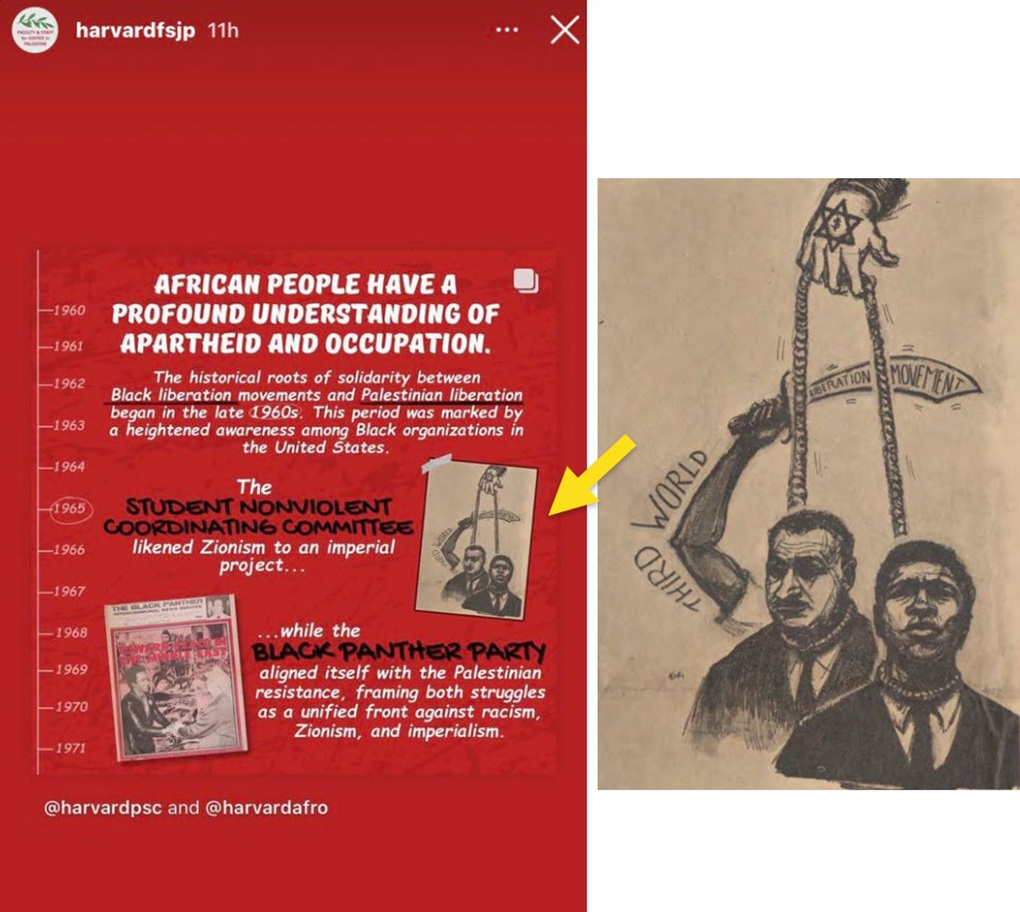
Harvard FSJP shared this graphic on its Instagram story showing a hand, emblazoned with a dollar sign inside a Star of David, holding a noose around the necks of Gamal Abdel Nasser and Muhammad Ali. (Screenshot/Instagram)
Months later, on May 3, 2024, Professor Ibrahim Aoude, a member of the University of Hawaii’s FSJP chapter (called Students and Faculty for Justice in Palestine), claimed during his speech at a Day of Action Teach-In for Palestine, that Antony Blinken was prioritizing his Jewish identity over his role as then-U.S. Secretary of State. Aoude stated, “Blinken... went to the state of Israel and Palestine...as a Jew, not as an American Secretary of State.... But not any kind of Jew—a Zionist Jew for sure. And the proof of this is what he's been doing since October 7th.”
In January 2025, the Whittier College chapter of FSJP shared a clip on its Instagram story of Chris Mokhiber, a guest on the Jadaliyya podcast hosted by FSJP National Steering Committee member Bassam Haddad, in which Mokhiber claimed that Zionism has “proven to be highly destructive of institutions and norms in the West” and “has corrupted governments... [and] media corporations that have had to swear allegiance to this particular political ideology.” Mokhiber further claimed that “even the sacred cow in the US of so-called free speech or the First Amendment is being willingly slaughtered in defense of Zionism now in the US.”
In August 2025, FSJP Bryn Mawr-Haverford College (Bico) posted a cartoon to its Instagram story of a character with a Jewish Star of David on his chest first attempting to hide or downplay news about the war in Gaza. The next panel shows the character appearing to deny or care about the news once they “realise [sic] there are no consequences."
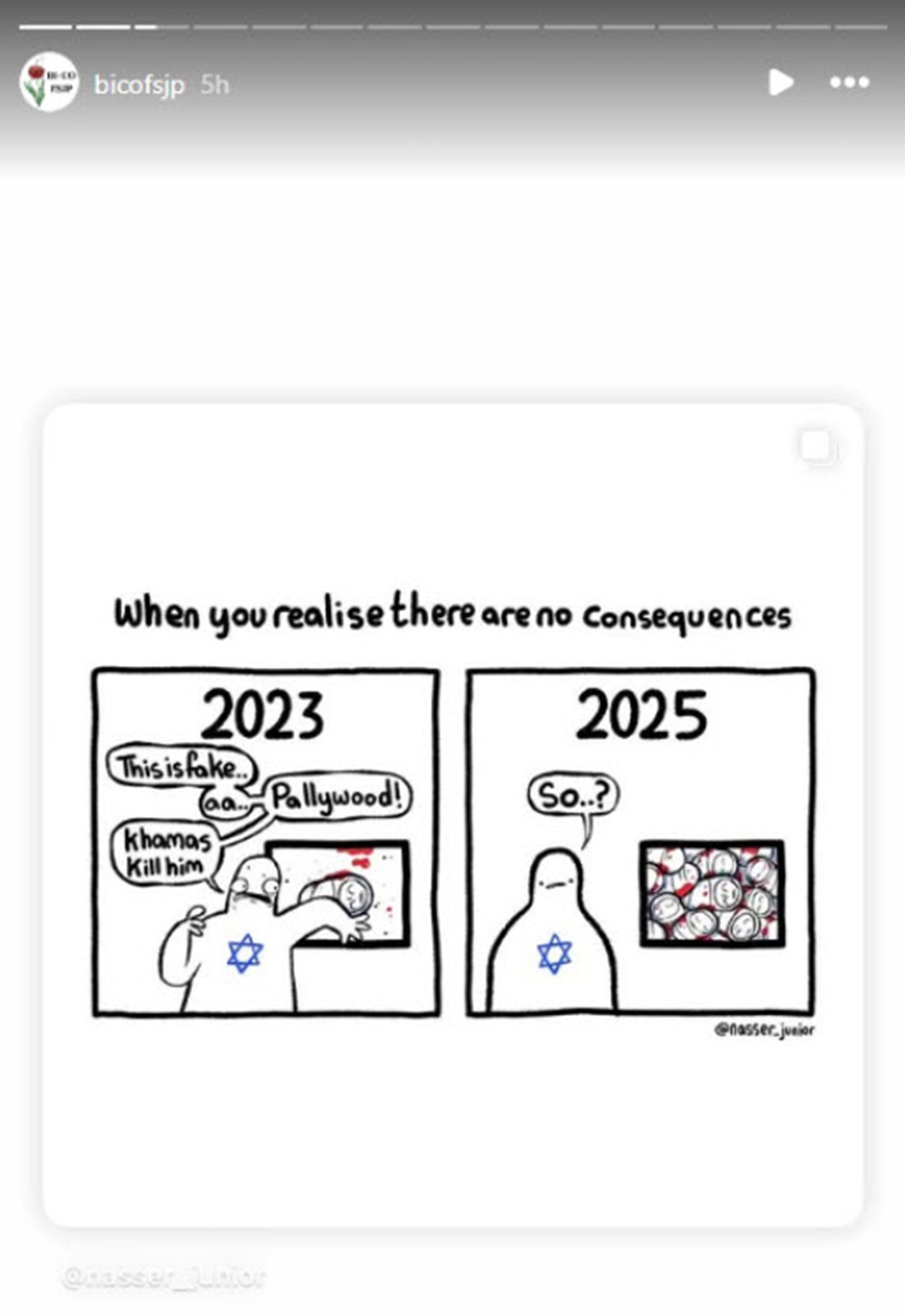
Graphic shared on Instagram by FSJP at Bryn Mawr-Haverford (Bi-Co). (Screenshot/Instagram)
Campus Activities
FSJP’s activities include pressuring university administrations to cut ties with Israeli institutions; organizing, participating in, and supporting students who lead anti-Israel protests, encampments, walkouts, teach-ins, and rallies; and publicly opposing the adoption of the International Holocaust Remembrance Alliance (IHRA) Working Definition of Antisemitism.
In collaboration with SJP and other groups, FSJP chapters often host panels, teach-ins, and academic events that present Zionism as inherently oppressive or colonialist. These events are typically framed as scholarship or dialogue, giving them broader reach and credibility.
FSJP has been prolific in organizing on-campus anti-Israel demonstrations and events, and in a few cases was even involved in the planning and leadership of encampments and building takeovers during the 2024 spring semester.
In May 2024, FSJP’s New School chapter in New York City established one of the first confirmed faculty-led anti-Israel encampments, which coincided with a nationwide surge of antisemitic incidents during this period.
That same month, a Columbia English professor and member of the university’s FSJP chapter brought one of his classes to the encampment tents, speculating to the New York Times that two of his Israeli students, who he believed were former members of the Israeli military, did not show up because “the class was not running in their favor.”
Another key pillar of FSJP’s work has been to attempt to legitimize student violations of codes of conduct during anti-Israel protests and shield them from disciplinary consequences.
For example, in April 2024, the FSJP chapter at Columbia University, Barnard College, and Teachers College used the "Gaza Solidarity Encampment" to issue a series of demands, including a call for faculty to stage an "academic boycott of all events” and Commencement. The coalition also demanded that the universities halt all disciplinary proceedings and lift student suspensions related to encampment activities and alleged violations.
FSJP events have also featured defense of the October 7 attack and its perpetrators.
In October 2024, at an anti-Israel rally celebrating the anniversary of Hamas’s October 7, 2023, attack, organized by FSJP and several student groups at the University of California, Berkeley, protesters displayed signs with messages that included: “Long Live Al-Aqsa Flood” (referencing Hamas’s name for its October 7 attack).
In that same month, during a protest organized by FSJP at the University of Pennsylvania, protestors chanted, “Resistance is not terrorism” and “From the river to the sea, Palestine will be free,” a slogan commonly used within the anti-Israel movement to call for the conquest and erasure of all of Israel.
In May 2025, the FSJP chapters at the University of Pennsylvania, Drexel University, and Bryn Mawr-Haverford College (Bico) were among the co-organizers of a protest at which protestors displayed the flag of the PFLP, along with signs reading “Long Live the Intifada” and “Victory to the Resistance,” a phrase commonly used to euphemistically indicate support for the U.S.-designated terrorist group Hamas.
Separately, in January 2025, FSJP at Ohio State University promoted a protest outside an off-campus Chabad house that was hosting an event with two former IDF soldiers, during which attendees were called “baby-killers” and were told to kill themselves.
Funding
The funding sources for the national network of FSJP are unknown. Much of the chapters’ work, which includes open letters, statements, and supporting candidates for university senate, does not appear to require significant fundraising. There are no donation options on the national or local chapters’ websites or social media accounts. Neither NFSJP nor any of its chapters appears to be registered with the IRS as a tax-exempt organization.


