Understanding Targeted Violence: Becoming an Upstander
Tools and Strategies
The difference between a foiled plot and a tragedy can be just one person. Learn why it's important to speak up about concerning behaviors, and how to do it
Behavioral Threat Assessment and Management (BTAM): A Guide for Law Enforcement
Tools and Strategies
Behavioral Threat Assessment and Management (BTAM) is a proactive, evidence-based approach to identify, assess, and help individuals who exhibit concerning and threatening behaviors. The goal is to prevent violence before it happens by connecting individuals with appropriate support and resources. BTAM helps law enforcement understand the current threat environment and how different factors affect each community. There are several resources available on BTAM best practices, including the…
Behavioral Threat Assessment and Management (BTAM): A Guide for Educators
Tools and Strategies
Behavioral Threat Assessment and Management (BTAM) is a systematic, evidence-based process used by schools, workplaces, and law enforcement to identify, assess, and manage individuals who may pose a threat to themselves or others. The model provides a structured way to notice warning signs, understand what they mean, and take action before anyone gets hurt. BTAM helps answer important questions like: Is this person in crisis? Are they at risk of hurting themselves or others? What support do…
When Fandom Meets Hate: Antisemitism in the True Crime Community (TCC)
Article
Antisemitism in the TCC shows up as casual slurs and inside jokes; admiration for antisemitic killers; extremist iconography like swastikas; and as part of how an attacker frames their violence.
What is Behavioral Threat Assessment and Management (BTAM)?
Tools and Strategies
BTAM helps schools, workplaces, clinicians, and law enforcement spot warning signs in persons who may be in crisis and intervene before violence occurs.
A loosely connected global network of online actors involved in illicit and harmful activities, like swatting, sadistic online exploitation (SOE), ransomware attacks, and distributing child sexual abuse material.
The Memetic Violence Field Guide: Terms, Symbols, and Phrases in Violent Online Subcultures
Tools and Strategies
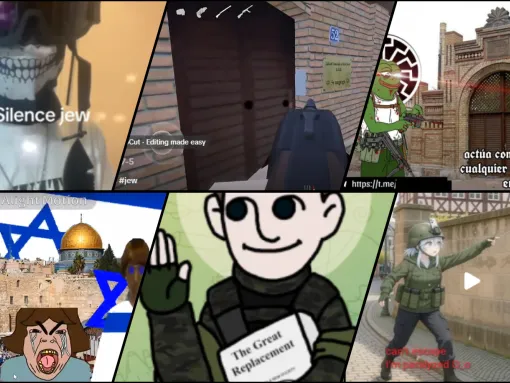
A glossary that explains some of the popular terms, references, and images used to signal transgression and belonging in online communities that glorify mass violence and extremist killings.
Short Dialogues with AI Reduce Belief in Antisemitic Conspiracy Theories
Report
A groundbreaking study supported by ADL found that fact-based dialogues with a trained AI chatbot durably reduced antisemitic conspiracy beliefs and increased favorability toward Jews.
Two Years of Turmoil: The Strategic Evolution of Anti-Israel Activism on U.S. Campuses and 2025–2026 Challenges
Report
ADL examined the strategic evolution of anti-Israel activism on U.S. campuses and provides recommendations for universities to respond proactively to changing tactics.
In some ways, summer 2026 offered Israelis and Jews a sense of relief that had been elusive since Hamas’ October 7, 2023, attack on Israel. For the first time, no hostages remained in Gaza and a ceasefire with Hamas brought a measure of calm after more than two years of war. While the possibility of renewed attacks from Iran remained a source of anxiety, the relative quiet allowed many Israelis to begin returning to familiar routines. According to Israeli tourism industry estimates,…
Norway’s Double Standards: How the World’s Largest Sovereign Wealth Fund Targets Israel
Report
This white paper examines the double standard in Norway’s sovereign wealth fund, revealing that Israeli companies face the highest exclusion rate of any country.
Artificial intelligence is rapidly reshaping how people consume and trust information—including what books they read. Amazon, the world’s largest bookseller, uses Large Language Models (LLMs) to generate short, snappy summaries of customer reviews. While this may be useful when applied to bedsheets or kitchen appliances, applying AI to book reviews—without human oversight—is proving to be deeply problematic. We found that AI-generated reviews are promoting books that…
Editing for Hate: How Anti-Israel and Anti-Jewish Bias Undermines Wikipedia’s Neutrality
Report
Co-produced with Builders For Tomorrow Executive Summary ADL has identified extensive issues with antisemitic and anti-Israel bias on Wikipedia in multiple languages. These issues include 1) a coordinated campaign to manipulate Wikipedia content related to Israel, the Israeli-Palestinian conflict, and similar issues, in which a group of editors systematically evade Wikipedia’s rules to shift balanced narratives toward skewed ones, spotlighting criticism of Israel and downplaying…
Hate in the Cascade States: Extremism & Antisemitism in Oregon & Washington
Report
This report provides a snapshot of antisemitism and extremism in Oregon and Washington, highlighting key trends tracked by the ADL Center on Extremism.