







Educators surveyed in a 2025 RAND study said that after school curricula and U.S. Holocaust Memorial Museum materials, YouTube is their most-used supplement for teaching the Holocaust and related Jewish topics. Although its videos are free and visually engaging, their quality varies; for example, Vox’s “The Israel-Palestine Conflict: A Brief, Simple History” can appear more reliable than it is. Vox itself is an American news and opinion website that leans towards the political left. One of Vox’s guiding principles is: “explanatory journalism is a public good.” Such a statement and belief in providing context and background to complex stories for increased audience understanding is quite appealing to educators. Vox’s video “The Israel-Palestine Conflict,” in particular, is roughly 10 minutes in length. A video like this is understandably appealing for teachers who want a concise summary of the Israel-Palestine conflict. However, such a short format requires glossing over crucial details and complex historical events, resulting in misrepresentations and a distorted version of history making the video inadequate at best for classroom instruction. The resources below equip parents and caregivers to request richer, more balanced material on the Israel-Palestine conflict in place of that Vox video.
What Makes the Vox YouTube Video: “The Israel-Palestine Conflict: A Brief, Simple History” Problematic?
Since its launch in 2016, Vox’s YouTube video, “The Israel-Palestine Conflict: A Brief, Simple History,” has received over 27 million views. Vox is an American news and opinion website that seeks to explain the news and complex issues in an accessible way for a general audience. While this approach is laudable, it can lead, as in this case, to oversimplification and misleading presentations that blur the line between fact and opinion and omit crucial context. While it may be appealing for an educator to find a resource that offers a “brief” overview, this is not the best approach when navigating a complex and nuanced history—especially with young people. The video begins by dispelling the myth that the conflict is a centuries-old religious dispute–a promising start, as the conflict is roughly a century old and largely about two groups claiming the same land. However, several problems quickly emerge: the video advances ideological claims, privileges the perspective of one party to the conflict (the Palestinians), and does not clearly distinguish between opinion and fact.
“The Israel-Palestine Conflict: A Brief, Simple History” presents a complex historical topic without adequate accuracy and nuance, failing to ascribe agency evenly among the groups involved and leaving viewers with an incomplete understanding of historical causes and effects. Teachers need more precise and objective materials when it comes to teaching about the past. Explore the sections below for a non-exhaustive exploration into key areas of what makes the Vox YouTube video: “The Israel-Palestine Conflict: A Brief, Simple History” not suitable for classroom instruction and advocacy tools to assist in facilitating productive conversations with educators.
Part I: Key Problematic Areas of the Vox YouTube Video: “The Israel-Palestine Conflict: A Brief, Simple History”
- The video describes “the region along the eastern Mediterranean we now call Israel-Palestine” as if “Israel-Palestine” were a universally accepted name for the area. A more accurate term to describe the region would be Israel and the Palestinian Territories
- Later in the video, the narrator states, “Israel was now occupying the Palestinian territories, including all of Jerusalem and its holy sites.” This language falsely suggests that Jews have no legitimate claim to the Temple Mount and Western Wall, the two holiest sites in Judaism.
- The video describes the current conflict as "unbearable for Palestinians,” inserting an editorial judgment while omitting the multitude of security threats and instability Israelis face on a daily basis. Framing the current conflict in this way only serves to privilege the perspective of one party, which does not allow for robust and complete instruction on the topic.
- This video consistently uses politically charged language like "occupation," and a singular perspective that ignores the diversity of Israel and Israelis, which demonstrates its anti-Israel bias. For example, it equates Israel only with Jews and pits Jews vs. Palestinians, ignoring the demographics of Israel which today include 20% of the population being non-Jewish--including Palestinians, Arabs, Christians, Druze, and others.
- The video uses very deliberate language to describe the “Intifada.” The narrator states with regard to the First Intifada, “It began with mostly protests and boycotts, but soon became violent and Israel responded with heavy force.” Such framing downplays the violence and outright terrorism experienced by Israelis during the First Intifada; the period included widespread attacks on civilians—stabbings, shootings, Molotov cocktails, rock-throwing at vehicles and lynchings —and the emergence of Hamas as a terrorist organization. With the Second Intifada, the narration only states that “it was much more violent than the first,” but in reality it was a sustained and coordinated terror campaign targeting Israeli civilians through mass-casualty suicide bombings on buses, cafés, and markets; shootings; stabbings; and later rocket fire, killing hundreds and injuring thousands over multiple years—carried out by terrorist groups including Hamas and Palestinian Islamic Jihad. By omitting the details on the escalation of violence faced by Israeli citizens, the video frames the “heavy force” by Israel as unwarranted or even disproportionate. In the aftermath of the October 7th attacks, the slogan “Globalize the Intifada” became commonplace at many anti-Israel protests and is understood as a call for violence against Israelis and Jews around the world.
- The video states, “in the first decades of the 20th century, tens of thousands of European Jews moved there.” Mass Jewish immigration to the region actually began in the 1880s, a fact supported by the video’s own graph (shown at 1:05).
- Lessons to explain why Jewish people emigrated in this period: the history of European antisemitism, The Founding of Israel: Explained; A Brief History of Israel etc.
- Since 1948, most Arab and Muslim countries have been hostile to Israel, with some disseminating antisemitic propaganda, funding terrorist attacks that target Israeli citizens, Jews and non-Jews alike, and inciting outright wars against Israel (like in 1948, 1967, 1973 and 2006, to name a few). The video glosses over decades of attacks, framing the conflict as a powerful Israel imposing its will on an oppressed Palestine, ignoring the many countries, ideologies, and terrorist organizations that have not participated productively in many opportunities for peace talks and seek to destroy Israel.
- After describing the peace treaty between Israel and Egypt, the video states, “the other Arab states gradually made peace with Israel, even if they never signed formal peace treaties.” This is misleading. Of Israel’s three other immediate neighbors–Jordan, Syria, and Lebanon–only Jordan could reasonably be described as having peaceful relations with Israel. In addition to participating in numerous wars against Israel beginning in 1948, Lebanon and Syria have hosted terrorists who have attacked Israel. For instance, starting in the 1980s and continuing through the Israel-Hamas war that began in 2023, the terrorist group Hezbollah, based in Lebanon, has carried out attacks against Israelis and Americans.
- When describing the British Mandate period (1920-1948), the narrator states that “tensions between Jews and Arabs grew” and “both sides committed acts of violence.” This passive, vague language obscures actual events, so that by the time the narrator states, “Jewish militias formed to fight both the local Arabs and to resist British rule,” viewers are left with the impression that only Jews had agency and acted as aggressors. The video omits local Arabs’ reactions to growing Jewish immigration, including multiple riots like the 1929 Hebron massacre where 69 Jews were murdered, the Arab Revolt of 1936-1939, and the effects of this violence on Jews and the British.
- Likewise, the video describes the Oslo Accords as the “big, first step toward Israel maybe someday withdrawing from the Palestinian territories, and allowing an independent Palestine,” as if Israel were the only party to the negotiations with obligations and therefore fully responsible for Oslo’s failure to achieve lasting peace. While the Oslo Accords established the framework for a transitional period towards greater Palestinian autonomy, the Palestine Liberation Organization (PLO), the internationally recognized official representative body of the Palestinian people, also had obligations, including recognizing Israel's right to exist and renouncing violence.
- The video describes the Second Intifada as “much more violent than the first” and “by the time it wound down a few years later, about 1,000 Israelis and 3,200 Palestinians had died.” This language presents the violence as impersonal and inevitable, omitting crucial context about the actions of Palestinian terrorists who used suicide bombings and shootings to murder Israeli civilians in restaurants and on buses. It also implies that the violence wound down on its own, failing to mention a major factor in reducing attacks: Israel’s construction of a security barrier that prevented terrorists from entering Israel from the West Bank.
Conclusion
It is no surprise that an approximately 10-minute video, coupled with the claim of a “brief” and “simple history,” appeals to educators. Such a short length, however, is unable to delve into the nuance, detail and history required to teach such a complex conflict. Vox’s “The Israel-Palestine Conflict: A Brief, Simple History” contains documented anti-Israel bias, and therefore cannot be considered an accurate tool in teaching about the conflict.
Rather than relying on short, pithy summative videos, teachers should follow the lead of many curricula on the Israel-Palestine conflict which include multiple lessons over several full class periods and focus on primary historical sources. Only such a comprehensive approach can cover the necessary material for students to understand the background to the current conflict.
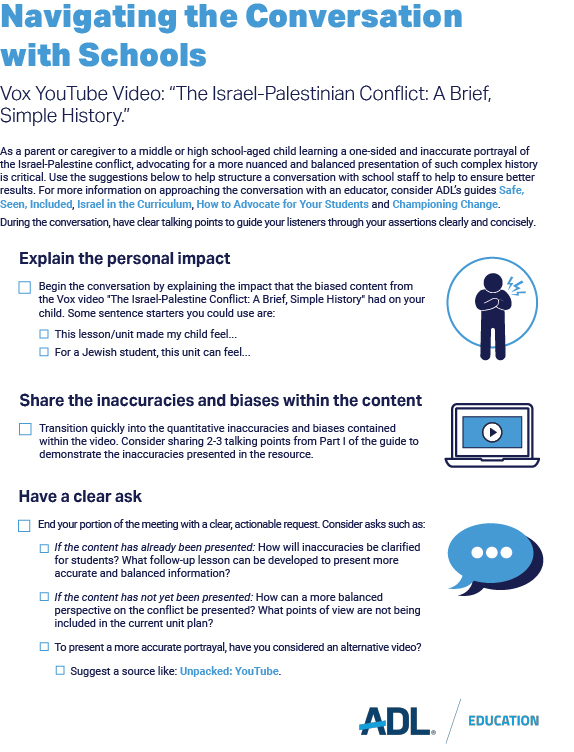
Part III: Additional Resources
- Championing Change: How Parents and Families Can Address Antisemitism in Schools
- Safe, Seen, Included: A Family Toolkit for Supporting Jewish Students
- How to Advocate for Your Students at their K-12 School
- Israel in the Curriculum
- Antisemitism Today
- The New Antisemitism and the Three Ds
- A Brief History of Israel