






In a world that is increasingly connected through social media, educators often incorporate current events into instruction. While this is an important tool for educators to make learning feel relevant and current for students, it also must be done with thought and care. Many curriculum offerings claim to offer educators resources and guidance on integrating complex current events into their classrooms, like the Israeli-Palestinian conflict. Sometimes these offerings, while claiming to provide guidance and nuance in material selection for educators, instead are filled with inaccuracies, bias, misinformation and singular viewpoints. Unfortunately, the curricula offered by Teach Palestine lacks the nuance and balance required to support the instruction of the complexities of the Israeli-Palestinian conflict. The resources below are designed to assist parents and caregivers in advocating for more balanced and nuanced resources.
What is Teach Palestine?
The stated purpose of the Teach Palestine website is to provide teachers with materials on the Palestinian people and the history of the Israeli-Palestinian conflict. The site includes a range of resources with varying levels of detail, ranging from blog posts by teachers about how they approach certain subjects to full lesson plans complete with primary source documents. These resources, however, are significantly biased. To cover a complex topic like the Israeli-Palestinian conflict requires balanced, accurate teaching materials that do not advance particular ideological positions or privilege the perspective of one party of a conflict. Teach Palestine’s resources fail to live up to these standards and therefore make their materials insufficient to support instruction on this topic. Explore the sections below for more insight into Teach Palestine’s curricula and advocacy tools to assist in facilitating productive conversations with educators.
Part I: What Makes Teach Palestine Problematic?
Few of Teach Palestine’s resources contain substantial historical background–a critical shortcoming for instructional materials for K-12 social studies classrooms, especially when intended to provide “historical context in which to situate current events.”1 Several resources include brief summaries of the Israeli-Palestinian conflict for teachers, but these summaries omit key information, resulting in an inaccurate portrayal of the conflict as a one-sided affair in which Israel subjugates the Palestinian people. For example:
- An introductory resource for teachers entitled “Understanding Palestine” defines Palestine as “the geographical territory between the Mediterranean Sea and the east bank of the Jordan River,” and mentions Palestinian Arabs’ roots in the region. The same section omits any reference to the historical Jewish presence in the region, inaccurately implying that Palestinian Arabs were its sole inhabitants until after World War I. These historical omissions serve to erase Jewish history and the Jewish connection to the Land of Israel, while simultaneously overlooking historical facts.
- The same resource (“Understanding Palestine”) describes the displacement of Palestinians during Israel’s 1948 War of Independence, while providing no background on the Arab invasion which started the war or the role of Arab leaders in encouraging Palestinians to leave the area. The resource also leaves out the roughly 820,000 Jewish refugees from Arab countries, who were forced to leave those countries in the years immediately following Israel’s independence, most of whom found refuge in Israel.
- The resource “Understanding Palestine” goes on to characterize the 2023-2025 Hamas-Israel War as “The most recent iteration of genocide and ethnic cleansing” while failing to even mention the Hamas attack on Israel on October 7, 2023, the murder of 1200 people and the taking of 251 hostages, and the violence that continued throughout the current conflict. This erasure of critical historical information presents the current Israel-Hamas War as one started without provocation and serves to vilify Israel.
Many lessons in Teach Palestine’s curricula uncritically assert ideological positions instead of teaching history from a neutral, fact-based perspective. Robust and strong historical instruction allows students to learn critical thinking skills, explore all perspectives and evaluate fact from opinion. Teach Palestine’s curricula does not meet these standards and presents a biased and ahistorical lens into a multifaceted conflict. For example, the lesson “Stolen Land,” described by its author as “a unit comparing walls in Palestine and in the United States,” is designed to convey to students “that the issues facing Palestinians in 1948 or First Nations people and Mexicans in 1848 remain with us today.” The lesson contains numerous inaccuracies and biases, including:
- The title promulgates the idea that the establishment of the State of Israel involved theft of land from indigenous Palestinian Arabs. It omits the important detail that Jews have lived continuously in their ancestral homeland of Israel for thousands of years and legally obtained the majority of the land they developed in the late 19th and early 20th centuries. It also ignores the history of Jewish sovereignty and ongoing connection to the land and the role of the United Nations in proposing the creation of a Jewish State and an Arab State in 1947 – which the Jews accepted but the Arabs rejected--before Israel was invaded by its Arab neighbors after declaring independence.
- The lesson lumps Palestinians, Native Americans, and Mexican immigrants to the United States in the same category. These groups faced radically different historical circumstances, none of which are covered in the lesson. Indeed, the lesson openly states the reason they are grouped together: not to illuminate history but to initiate “conversations that lead to activism on the ground.” In other words, the lesson’s purpose is to encourage students to engage in political advocacy for sanctioned ideological causes. This same strategy is employed in the lesson “Borders and Walls,” meant to “help students see the similarities in the ideology behind the conquest of the Americas […] and Palestine.” By suggesting the experiences of Palestinians, Native Americans, and Mexican immigrants are the same, the lesson erases the unique experiences of these groups as opposed to exploring the unique histories of these groups.
The final section of the “Stolen Land” lesson recommends students perform fictional demonstrations of the lesson’s claims of violence and oppression:
- In a reenactment of a scene at the US-Mexico border, students “built a wall and acted out a scene in which some of them were caught and arrested and others were shot.”
- Another reenactment involves a scene in which students pretend to be Israeli soldiers forcing a pregnant Palestinian woman to expose herself and give birth at a checkpoint. The scene characterizes the Israeli soldier as cruel, malicious and indifferent.
The scenarios provided in this particular lesson present hypothetical situations that depict one party (i.e. Israelis) as evil and the other party (i.e. Palestinians) as victims—this choice presents an oversimplification of complex historical and current events, and ignores trauma experienced on both sides. Rather than promoting historical inquiry through primary sources, the lesson’s scenarios encourage students to imagine acts of violence and oppression. In addition to being of dubious pedagogical merit, classroom simulations can be emotionally traumatizing for students.2
Finally, public schools should never allow students to perform acts of violence or subjugate one another. Such activities force students into roles of defending and/or identifying with oppressors and can be upsetting or damaging for students who may identify with the victims or for other reasons. View more information on why simulation activities like these should not be used.
Another example comes from the lesson “Teaching Palestine/Israel: A Multiple Narratives Approach.” Teaching both sides’ perspectives in a historical conflict can be a useful pedagogical technique when handled with appropriate balance and care. However, such approaches can be dangerous when covering acts of violence such as terrorism, as they can imply that both “sides” are equally valid or meritorious. In this lesson, students read speeches by George W. Bush and Osama bin Laden on the causes and effects of the September 11th attacks against the United States. Without adequate context, such comparisons can serve as a pretext for justifying violence. Furthermore, these sources are not even relevant to the Israeli-Palestinian conflict
Conclusion
When choosing a curriculum on the Israeli-Palestinian conflict, educators should ensure that the following topics are fairly addressed:
- Curricula should cover the historical presence in the region of both the Jewish and Palestinian peoples, including the periods of Jewish sovereignty in ancient Israel and the arrival of Arab Muslims beginning in the 7th century CE.
- When addressing the displacement of Palestinians following the 1948 Arab-Israeli War, instructional material should also cover the expulsion of a similar number of Jews from Arab countries throughout the Middle East.
- Instead of supporting one national claim over another, materials should address the land claims of both Israelis and Palestinians.
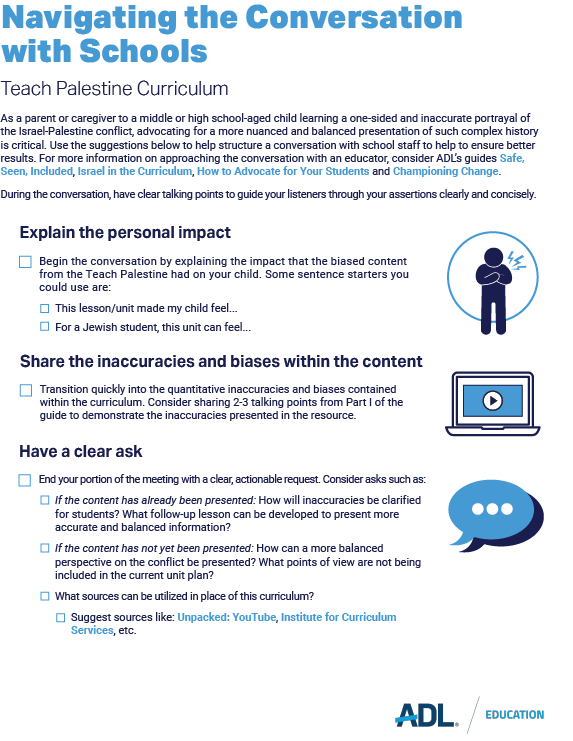
Part III: Additional Resources
- Championing Change: How Parents and Families Can Address Antisemitism in Schools
- Safe, Seen, Included: A Family Toolkit for Supporting Jewish Students
- How to Advocate for Your Students at their K-12 School
- Israel in the Curriculum
- Antisemitism Today
- The New Antisemitism and the Three Ds
- A Brief History of Israel