








Teach for Liberation: Ida in the Middle Unit
Through books, educators are able to support students’ exploration of different points of view, experiences, places, time periods, etc. These are vital offerings in classroom instruction. Sometimes, however, unit plans that purport to offer educators guidance and nuance in presenting materials in their classrooms instead have inaccuracies, bias and misinformation. The guidance below demonstrates how unbalanced unit guides can be problematic when exploring a work of fiction.
What is Ida in the Middle and Teach for Liberation?
Teach for Liberation's Ida in the Middle unit guide provides instructional materials to accompany Ida in the Middle, a fictional novel about a young Palestinian-American girl discovering her identity. The guide is intended for English language arts or social studies teachers in grades 6-9. Ida in the Middle offers a specific viewpoint on a complex, multifaceted conflict. Exploring different perspectives through works of fiction is a common practice in schools. Books can serve as windows into cultures and identities that differ from our own. They can also be mirrors to reflect back our own experiences. When using novels in this way, it’s important to be prepared for conversations with students about separating opinion from fact. Unfortunately, the unit guide created to accompany Ida in the Middle by Teach for Liberation does not provide the necessary context or framing to support an exploration of the historical background they claim to provide.
Teach for Liberation is an educational consulting organization “committed to anti-racist, anti-imperialist, anti-bias teaching through the active decolonization of our education system.” Their website states that Teach for Liberation aims to fill a gap and to provide “authentic anti-bias work,” focusing on “historical and sociological context, relationships, and identity.” Teach for Liberation created the guide, which is hosted on the novel’s website and endorsed by the author. The unit guide for Ida in the Middle is marketed as including lessons that “are rooted in anti-racist and anti-bias practices”--while the unit guide may aim to center a specific perspective, the prejudice within the choices for the lessons highlights both anti-Israel bias and antisemitic tropes. Because of the bias throughout the unit guide from Teach for Liberation, it is not an appropriate source to use with young people. The unit guide, created to accompany Ida in the Middle, is where parents and caregivers should focus advocacy.
Teachers sometimes use novels such as Ida in the Middle to provide literary perspectives on world conflicts. Ida in the Middle allows students to experience one specific point of view from the conflict and can be used to provide a balance of perspectives on the conflict if taught in conjunction with additional materials. The unit guide from Teach for Liberation claims to do much more, however, purporting to offer teachers “historical context, primary sources, and explanation of standards” for Ida in the Middle and the Israeli-Palestinian conflict. When it comes to teaching historical and current events, teachers need resources that are accurate and based on credible, unbiased sources. Just as importantly, they need objective materials that do not advance ideological claims or privilege the perspective of one party to a conflict. The unit guide falls short on these accounts and is therefore not a trusted source for educators. Explore the sections below for more insight into Teach for Liberation’s Ida in the Middle unit guide and advocacy tools to assist in facilitating productive conversations with educators.
Part I: What Makes Teach for Liberation’s Unit Guide Problematic?
Use the drop-downs below to explore specific aspects related to Teach for Liberation’s Ida in the Middle unit guide to learn more about what makes this resource problematic.
The unit guide links to a key resource titled “A Brief Historical Background of Palestine,” intended to help teachers address “gaps or misconceptions” in their background knowledge on the conflict. Written by the authors of the unit guide, the four-page document contains numerous historical inaccuracies and omissions, including:
- The source claims that the Jewish population who lived under Ottoman rule in the region that would become Israel, Gaza, and the West Bank enjoyed relations with other groups, especially the Muslim majority, that were “generally stable and peaceful.” The text makes no mention to periods of anti-Jewish violence, including pogroms, by Muslims and others, or the limited rights of non-Muslim Ottoman subjects, who were required to pay a special tax, wear distinctive clothing and, beginning in the 19th century, were increasingly subjected to violent persecution. More information can be found View more information. View more information.
- While focusing on the history of Palestinians in the land, the text makes no mention of ancient Israel, giving students the false impression that the ancestors of modern Arab Palestinians were the sole inhabitants of the region since ancient times. Indeed, Jews are presented throughout the resource as foreign colonists, with Zionism characterized as a “settler-colonialist” attempt to found a state for a people who are not indigenous to the region. These historical omissions are indicative of an overarching theme throughout the unit guide: the erasure of Jewish history and the Jewish connection to the Land of Israel.
Using trustworthy and balanced sources is critical to historical accuracy. Teach for Liberation’s Ida in the Middle unit guide includes links to external sources that are biased and inaccurate, including:
- The unit guide routinely refers to Al Jazeera as a source. Al Jazeera is a Qatari-government news outlet banned in several Middle Eastern countries for promoting violence and for its ties to the Iranian and Qatari governments. It has a documented history of bias against Israel and the U.S., Holocaust denial, and support for terrorist movements.1
- In an attempt to argue that Judaism’s “principles are in fundamental opposition with the Israeli government’s actions,” the guide includes a link to an article from Jewish Voice for Peace (JVP). JVP is a fringe anti-Israel organization that does not represent the views of most Jewish Americans, the majority of whom, according to recent Pew research, support Israel.2 Selecting a source from a small, fringe organization that represents a small minority of Jews would be akin to citing a flat-earther in a geology textbook to present an opposing view of scientific consensus–a disingenuous and misleading attempt to portray a minority position as representative of the mainstream.
- Throughout the guide, Israel is portrayed as a powerful evil entity, accused of apartheid. The guide uses antisemitic tropes such as power and money in discussing Israel. These charges then connect to all Jews as being powerful oppressors, conflating a complex conflict in the Middle East to race and policing issues in the United States.
1. Jerusalem Center for Security and Foreign Affairs, Al Jazeera–Feeding the Muslim Brotherhood’s Political Agenda to the Arab World, 2024
2. Pew Research Center, U.S. Jews’ connections with and attitudes towards Israel, 2020.
Rather than presenting history evenhandedly, the unit guide promotes ideological claims that favor a Palestinian perspective while omitting the Israeli perspective. This one-sided, activist approach is inappropriate for classroom instruction and more suited to political advocacy. For example:
- Regarding the conflict, the authors state: “It’s about land theft, expulsion and ethnic cleansing by foreign settlers to indigenous land.” The authors level these charges against Israel and its founders without any support or historical explanation. Furthermore, this loaded, accusatory language is one-sided, focusing exclusively on Palestinian grievances and implying Israel is solely responsible for the conflict.
- The unit guide asserts that Israel has no right to exist, partly because “no country has a right to exist.” These radical claims are presented as facts that teachers and students should simply accept.
Conclusion
If teachers want to present students with background information on the Israeli-Palestinian conflict to buttress their comprehension of the novel, they should instead turn to resources with more neutral, historically accurate information. One approach would be to supplement the novel with primary sources selected from databases like the Library of Congress online collections or the Yale Law School’s Avalon Project.
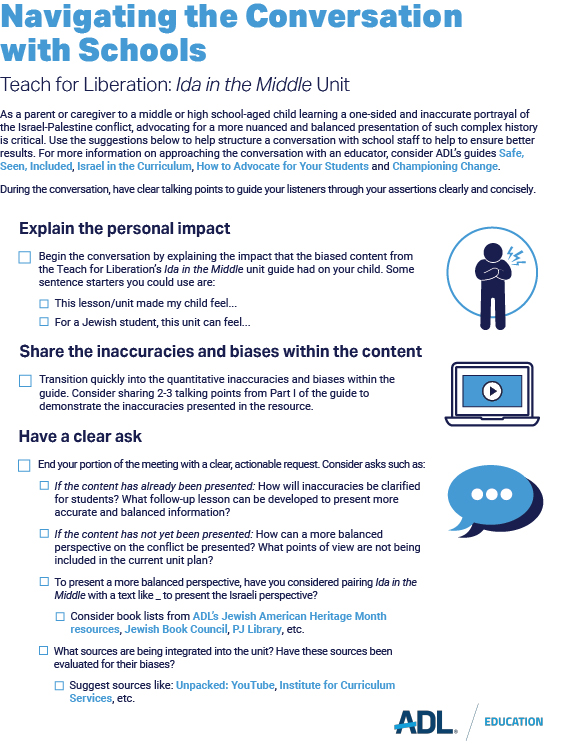
Part III: Additional Resources
- Championing Change: How Parents and Families Can Address Antisemitism in Schools
- Safe, Seen, Included: A Family Toolkit for Supporting Jewish Students
- How to Advocate for Your Students at their K-12 School
- Israel in the Curriculum
- Antisemitism Today
- The New Antisemitism and the Three Ds
- A Brief History of Israel