







Handala’s Return: A Children’s Story and Workbook
Books and stories allow people to experience new perspectives, times past and places far away. Educators select such resources for their classrooms to expose students to all of these elements. The Israeli-Palestinian conflict is one topic where educators look to books and stories to allow students to learn about different experiences within the conflict and to bring the history to life. Exploring different identities is something that should be encouraged especially at a young age. Educators should support their students with learning about their own culture and the cultures of other groups of people. However, when the learning goes beyond general understanding and encourages students to support political agendas, educators must be cautious to ensure developmental appropriateness. Educators should select narratives for their classroom with thought and care—ensuring that history and fact are presented accurately and with as much balance as possible. The resource "Handala’s Return: A Children’s Story and Workbook," unfortunately, lacks the nuance needed to be used in the classroom. The resources below are designed to assist parents and caregivers in advocating for more balanced and nuanced stories and texts to be utilized in classrooms to teach the Israeli-Palestinian conflict.
What is “Handala’s Return?”
The story and workbook “Handala’s Return,” produced by the Palestinian Feminist Collective, introduces students to the popular political cartoon character Handala, first illustrated in 1969 by the Palestinian cartoonist Naji al-Ali. Handala is a barefoot, ragged refugee boy with his back turned to the viewer. Geared towards elementary school students, the workbook features short comic strips about Handala and the history of his publication interspersed with artistic and handwriting activities.
While the workbook emphasizes Handala as a symbol of Palestinian national pride and resilience, it does so by demonizing Israel and its supporters. Rather than using Handala as a resource for introducing students to a historical perspective on the Israeli-Palestinian conflict, the authors instead make a political statement, attempting to indoctrinate students against Israel and Israel’s right to exist and encouraging students to engage in anti-Israel advocacy.
What little historical context the workbook offers is deeply misleading and presents a highly one-sided portrayal of the conflict. Due to these features, this resource is not recommended for use with young people. Explore the sections below for more insight into “Handala’s Return” and advocacy tools to assist in facilitating productive conversations with educators.
Part I: What Makes “Handala’s Return” Problematic?
The "Handala’s Return” workbook and story’s only coverage of the historical background to the Israeli-Palestinian conflict is contained in two short comic strips (5 pages out of the 28 total) which omit any information on the history of the region or the origins of the current conflict. The deliberate omission of additional historical facts results in an inaccurate and one-sided portrayal of the conflict in which Israel subjugates and oppresses the powerless Palestinian people. For example:
- The workbook omits any background on the origins of the modern conflict, instead summarizing decades of history in a single accusatory sentence on page 9: “A group of bullies called Zionists wanted our land so they stole it by force and hurt many people.” This sentence minimizes a complex and multifaceted conflict into something presented as a simple binary of bullies and bullied.
- In order to understand the Israeli-Palestinian conflict and the wider Arab-Israeli conflict, students need to understand:
- Jewish nationalism (Zionism) — the belief in the right of Jewish people to a sovereign state in their ancestral homeland or simply Israel’s right to exist.
- Arab and Palestinian nationalism.
- And the series of events that led up to the founding of the State of Israel, including the collapse of the Ottoman Empire at the end of World War I, British control over the region, and the United Nations vote to partition the land into independent Jewish and Arab states.
- Without this foundational knowledge, students cannot develop an accurate and nuanced understanding of this complicated history, the competing claims, and the ongoing conflict. The conflict cannot and should not be presented in a single sentence.
- In order to understand the Israeli-Palestinian conflict and the wider Arab-Israeli conflict, students need to understand:
- Several sections of the workbook establish the relationship between Palestinians and the region which today contains Israel, Gaza, and the West Bank, the first explicit example coming on page 6. However, the workbook makes no mention of the 4,000-year-old Jewish connection to the region or the continuous Jewish community which dwelt there through several expulsions and into the modern day. This omission deliberately minimizes the Jewish claim to the land of Israel and perpetuates the misconception that the Jewish people are “colonizers” in a land that is not their own.
It is important that educational materials, particularly those about complex and multifaceted conflicts, present information without bias towards one party alone. “Handala’s Return” not only omits historical fact for the purposes of communicating a specific narrative, but also the workbook and story deliberately depict Israel and the people who support its right to exist as evil bullies.
- Without historical context, "Handala’s Return” depicts the conflict as one-sided, with Palestinians as the innocent victims of unprovoked aggression from “Zionists”--i.e. Jews-- who stole their land. This gives students the impression that Israel and those who support its right to exist should be morally condemned. These language choices also imply one side is “good” (Palestinian) while the other is “bad” (Israeli), which avoids exploring the deeper complexities to the Israeli-Palestinian conflict.
- The narration claims on page 16 that “children like [Handala] keep having their homes taken by the Zionist bullies. They are always scaring them and arresting them.” This is the only detail presented to students about the Israeli-Palestinian conflict post-1948. The use of the terms “Zionist bullies” serves only to demonize an entire group of people – Jews --and simplifies an incredibly complex history. While the term “bully” is age-appropriate for an elementary school-aged child to understand, the connotation of it implies a power-imbalance and villainous nature, which only serves to demonize Israelis.
- Additionally, the claim inaccurately implies that children are specifically targeted in the conflict.
- The purpose of such statements is not to teach history. If it were, "Handala’s Return” would mention Palestinian violence against Israelis as well as multiple attempts at peace negotiations. Instead, it encourages students to believe that one side is righteous and the other evil and illegitimate. As history educators know, the history of this conflict is much more nuanced and must be presented as such.
Instructional materials in public schools should provide students with historical information to help them think critically about current events, without imposing an agenda or opinion. “Handala’s Return” fails in this regard, instead encouraging students to engage in one-sided political activism and to embrace an ideology that calls for the elimination of the State of Israel.
- In multiple instances, the workbook uses the phrase “Free Palestine.” While the phrase "Free Palestine" on its own is not considered to be antisemitic, its use in specific contexts (like this one) can be. The map on page 25 reveals what this innocuous-sounding phrase really means to the authors: it labels the entire region–including Israel, the West Bank, and Gaza–as “Palestine.” The implication is clear: the establishment of a Palestinian state in place of the Jewish state of Israel.
- The workbook explicitly encourages students to engage in partisan activism. An activity on page 18 asks students to fill in the blank after statements like: “I will write a letter to,” “I will raise funds for the children of Palestine by,” “I will chant this at a Palestine protest,” etc. These asks are not appropriate for elementary school-aged children to be engaging in while in a school setting—they encourage activism (and solicit monetary commitment) rather than educate on a topic.
Instructional materials in public school classrooms should not be used to promulgate one-sided political perspectives, much less explicitly encourage students to engage in partisan protests that they are too young to comprehend.
Conclusion
Because much of "Handala’s Return” is focused on positive aspects of Palestinian identity and the characteristics which Handala symbolizes, it can be easy for teachers to overlook the myriad problems with the workbook and story, many of which were discussed above. Unfortunately for educators looking to develop students’ understanding of Palestinian culture and identity, an appropriate learning objective for elementary students, the historical omissions, extreme position on the elimination of Israel and the political nature of the activities in this workbook make it not a suitable resource for elementary students. Given the complexity of the topic and the importance of teaching historical context rather than one-sided narrative, educators rely on guidance from their state education department and experts like the National Council for the Social Studies to consider how to incorporate different cultures and conflicts in an age-appropriate way. Such standards help ensure instruction is objective, historically accurate and given the time to delve into nuance and complexity. For teachers whose goal is to educate students about different identity groups rather than history, it is essential to ensure that instruction about one identity group does not involve disparagement or denigration of another—and that adequate time is given to multiple identity groups, rather than only platforming one.
While social studies standards nationally cover broad topics to allow educators to make selections to best meet the needs of their students, international historical topics that include violence between different groups and complex politics involving multiple wars are not likely to be age-appropriate for elementary school classrooms.
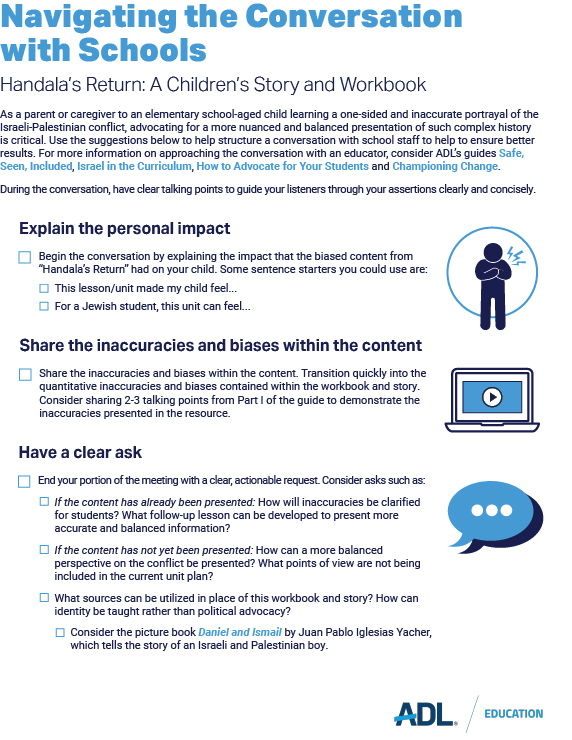
Part III: Additional Resources
- Championing Change: How Parents and Families Can Address Antisemitism in Schools
- Safe, Seen, Included: A Family Toolkit for Supporting Jewish Students
- How to Advocate for Your Students at their K-12 School
- Israel in the Curriculum
- Antisemitism Today
- The New Antisemitism and the Three Ds
- A Brief History of Israel
- Consider the picture book Daniel and Ismail by Juan Pablo Iglesias Yacher, which tells the story of an Israeli and Palestinian boy.