





Related Content
The True Crime Community (TCC)
June 18, 2026

NOTE: This backgrounder contains disturbing details and imagery that may be upsetting to some readers. Resources for addressing child exploitation, seeking support and filing complaints are available at the end of this article.
Key Points
- 764 is a decentralized, global network of online communities that glorify violence and engage in a range of criminal activities, including sextortion, the distribution of child sex abuse material (CSAM), swatting, SIM swapping and doxing.
- The network is known for targeting and exploiting vulnerable individuals online, particularly children.
- 764’s core beliefs are rooted in nihilism and misanthropy, although it also draws influence from extremist movements, most notably the Satanic neo-Nazi organization, Order of Nine Angles (O9A, ONA).
- While some members may hold extremist beliefs, most of their criminal and violent actions are driven by a desire to obtain status and influence within the 764 network, rather than by ideological or political goals.
Origins and Ideology
764 emerged in 2021 out of “The Community” (also known as “Com” or “Comm”), a loosely connected network of online actors and groups engaged in illicit activities such as hacking, swatting, SIM swapping, sextortion and the distribution of child sex abuse material (CSAM).
764 was founded by Bradley Cadenhead, a then-15-year-old from Stephenville, Texas. 764 takes its name from the first three digits of Stephenville’s ZIP codes: 76401 and 76402. Cadenhead, who went by “Felix” online, drew inspiration for 764 from a similar sextortion network called “CVLT,” which coerced children into performing sexual acts on camera and used the resulting material to further extort them. 764 expanded on CVLT’s methods, incorporating additional forms of abuse, such as self-harm and acts of animal cruelty. Cadenhead claims an individual he met through the online game Minecraft aided him in starting 764, though that person has never been identified.
764’s ideological framework is rooted in nihilism and misanthropy, promoting a worldview that rejects moral norms and sees no value in human life. The network also draws heavily—particularly in terms of aesthetics—from the Order of Nine Angles (O9A, ONA), a far-right extremist group that blends Satanism and the occult with neo-Nazi and accelerationist beliefs. Symbolism and terminology associated with O9A, as well as its U.S.-based nexion Tempel ov Blood (ToB), frequently appear in content from 764 and related groups like No Lives Matter (NLM). However, 764’s use of O9A material is driven more by its visual and symbolic impact than by any real ideological alignment.
Within violent extremist spaces, O9A stands out as one of the most obscene and transgressive groups to exist, making it a potent symbol for those seeking to promote shocking content and gain notoriety. Many individuals affiliated with 764 also exhibit a disturbing fascination with violence and mass murder, often idolizing school shooters, terrorists and other mass killers.
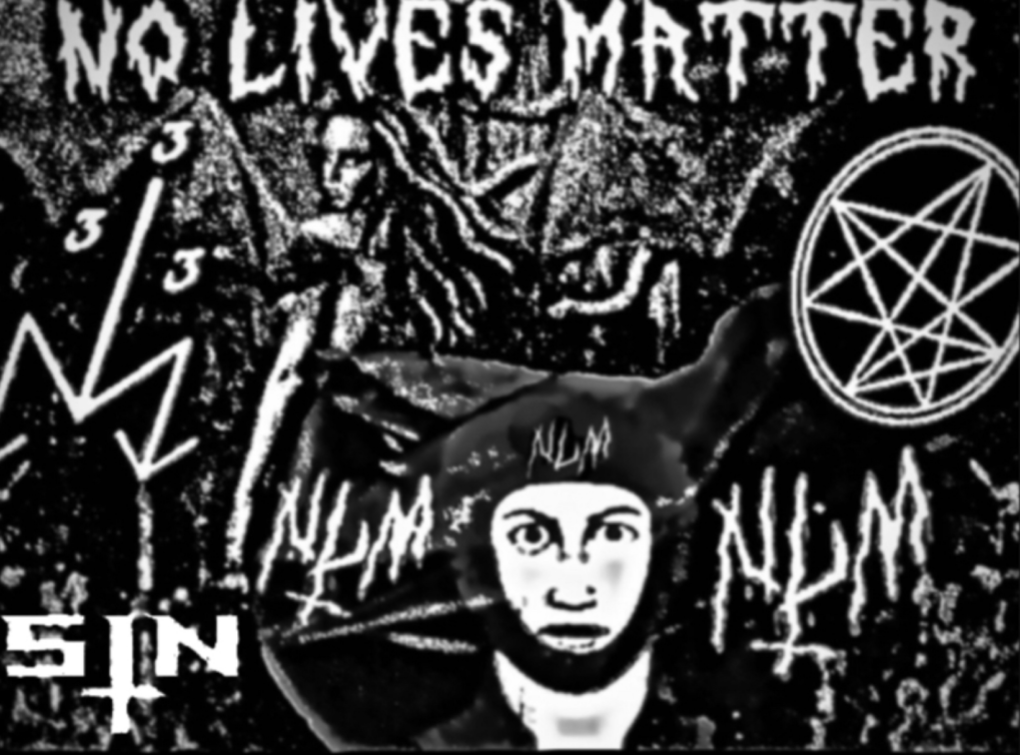
"764xNLM-Classified,” a manifesto issued jointly by 764 and No Lives Matter (NLM) in September 2024, includes a graphic featuring the ToB (upper left corner) and O9A sigils (upper right corner).
Unlike traditional extremist groups, whose actions are driven by specific causes or political goals, 764 members’ activities are typically fueled by a desire to gain influence and status within the network itself. For 764, violence serves no greater purpose—it is simply an end in itself — and members commit brutal acts purely for the sake of inflicting harm. This mindset sets 764 apart from other extremists, such as white supremacist accelerationists and violent Islamist extremists, who use violence with the goals of destabilizing society and forming a white ethnostate or a global caliphate, respectively.
By blending violent extremism, nihilism, and the exploitation of minors, 764 represents a dangerous, multifaceted threat that challenges conventional definitions of extremism and existing counterterrorism frameworks.
Recruitment and Victims
The 764 network is composed predominantly of minors, many of whom are not only victims but also abusers. Within the network, underage members have been observed grooming and exploiting fellow minors, using tactics that are promoted within the network's various handbooks and guides. The network has also drawn the attention of adult predators, who have collaborated with other members and exploited the network to target vulnerable youth.
764 members prioritize targeting online spaces that are frequented by minors and members of marginalized and vulnerable communities, such as LGBTQ+ youth and individuals struggling with mental health issues. The young player bases of online gaming platforms such as Minecraft and Roblox are frequent targets of 764, as are the audiences of spaces that host extreme graphic and violent content, sometimes referred to as “gore forums.” 764 members also frequently target youth in adjacent gaming and gore communities on Discord and other platforms.
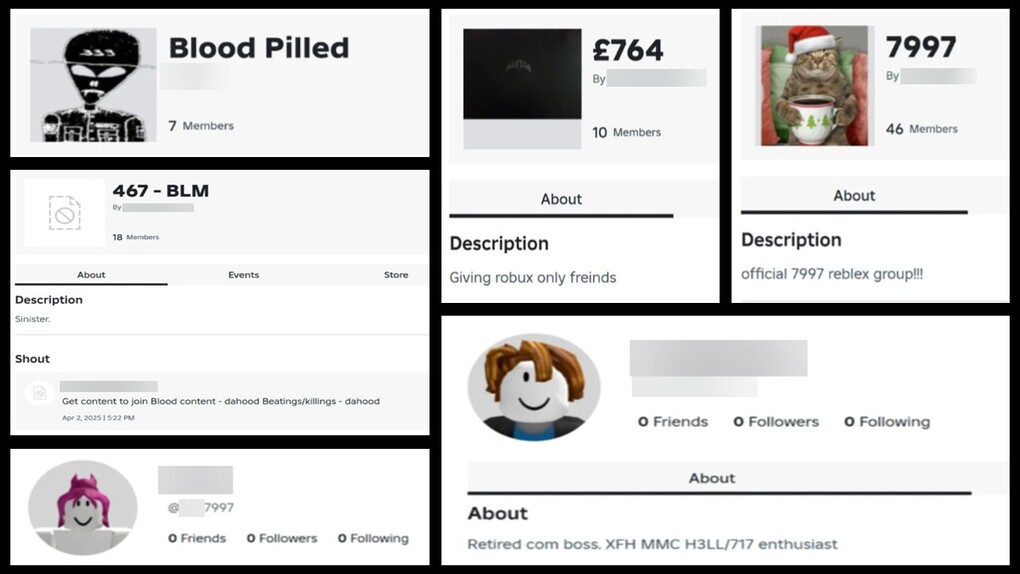
Examples of 764-affiliated groups and users on Roblox identified by ADL. These groups and users were reported by ADL to Roblox, which removed them in accordance with their policies. (Screenshots)
Once a potential victim is identified, 764 members will attempt to lure them into a private space, typically on Discord or Telegram. Invitations to these private spaces—as well as files shared with the victim—often contain keyloggers or IP loggers, enabling members to gain access to the victim’s personal information without their knowledge or consent. 764 members employ several techniques to lure victims into these private spaces, including offering in-game rewards or virtual currency for games like Roblox, or feigning romantic interest to coerce the victim into sharing personal or compromising information. Victims may also be forced to share sexually explicit photos of themselves or provide evidence of recent self-harm to gain access to these spaces.
Once successfully lured into a private space, victims are quickly subjected to an onslaught of harassment and intimidation, including grooming, sextortion, and threats of violence. While the relationship between a victim and a 764 member may initially appear voluntary, the connection is in fact coerced under false pretenses. Victims are often subjected to such severe abuse that they may begin to mirror their abusers, becoming perpetrators themselves rather than seeking help from trusted adults or law enforcement. 764 relies upon the trauma and fear it instills in its victims to enable continued growth. If victims feel shame for what they have done or fear the consequences of seeking help, they may be more likely to perpetuate the cycle of abuse than try and stop it.
Tactics and Activities
Within 764, members gain status through cruelty and abuse, with the most extreme and degrading acts they can coerce victims into committing, earning them the greatest influence.
Sextortion and Child Sex Abuse Material (CSAM)
The 764 network is primarily known for its involvement in the sextortion of minors. While their methods vary, 764 members use a combination of social engineering techniques, including love bombing, to groom victims and obtain compromising, sexually explicit photos and videos of them. Many of these techniques are outlined in manuals—such as the “Sextortion Handbook”—written by prominent 764 members and circulated within the network’s online chats.
While victims are typically targeted by a single abuser, the content they’re coerced into creating is rarely kept private. Abusers often share intimate photos and videos of their victims with other 764 members, particularly within the network's Telegram and Discord chats. A member’s influence and status depend heavily on the quality of “content” they produce—the more graphic and degrading it is, the more prestige they can accrue within the network.
Self-harm and other forms of abuse
Victims are often pressured to engage in increasingly extreme behaviors to test their “loyalty” to their abuser, such as killing family pets or asphyxiating themselves. Eating disorders are also encouraged and exploited, with victims being pressured to lose extreme amounts of weight. Some 764 members have even gone so far as to encourage victims to commit suicide on livestream—or carry out a mass shooting—for their own entertainment.
Self-harm, particularly cutting, is also extremely common among individuals associated with 764. One of the network’s most disturbing practices is cut signing, in which abusers demand that victims carve the abuser’s name or alias into their skin. These images and videos serve as a sort of currency within the network, with abusers using “cut signs” to demonstrate their “ownership” over a victim and obtain further influence within 764. Victims are also encouraged to create “fan signs” or “blood signs”—using their own blood to write their abuser’s name or alias on their bodies or other surfaces—to demonstrate their loyalty and submission to their abuser and 764.
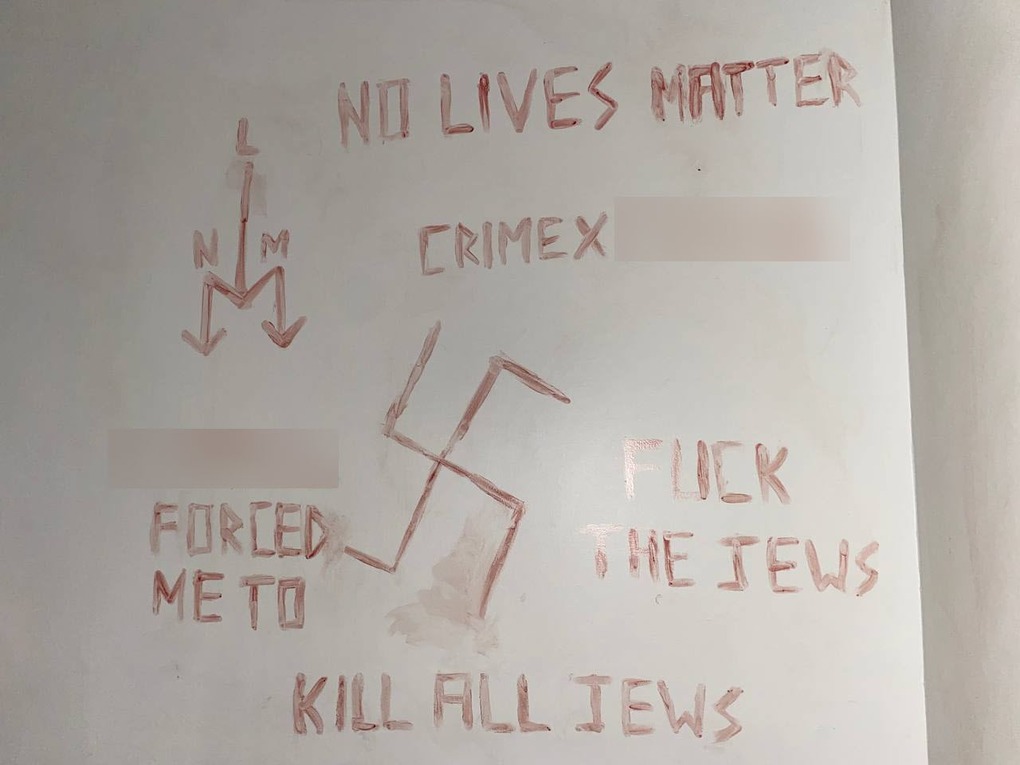
Example of a blood sign containing antisemitic rhetoric and pledging loyalty to an abuser affiliated with No Lives Matter. (Source: Telegram)
Intimidation, doxing and swatting
If a victim resists, abusers will often threaten to share their so-called “lorebook” — a digital compilation of the victim’s compromising photos and videos, private messages and personal information — with the victim’s family and friends. Many of these lorebooks, which feature victims under 18, are also posted publicly in 764 chats so that other members can harass the victim.
764 members use these lorebooks — as well as threats to dox and swat victims, their families and friends — to discourage them from reporting their abuse to a trusted adult or law enforcement. 764 silences its victims by instilling fear and shame, allowing its abusive activity to go unnoticed by parents, teachers and others in a position to help.
Researchers at the ADL Center on Extremism (COE) are also aware of several cases in which 764 members have used victims’ personal information to make false bomb threats or swat businesses and schools, with the intent of harassing the victims and damaging their reputations.
764’s role within the Com
The “Com" (short for “the Community”) is a loosely organized network of individuals and groups engaged in a broad range of illicit activities, including hacking, ransomware, sextortion, swatting, doxing and SIM swapping. 764 is the most influential group within the Com network and has spawned hundreds of copycats and imitators.
Terrorism scholar Dr. Marc-André Argentino has identified three primary spheres within the broader Com network: Cyber Com, which is focused on hacking and other cybercrimes; Sextortion Com, which is focused on sextortion and child sexual exploitation; and Offline Com, which is focused on promoting and engaging in offline violence. Many groups within the Offline Com—such as No Lives Matter (NLM) and Maniac Murder Cult (MKY)—openly embrace accelerationist and neo-Nazi ideologies.
Participation within the Com is fluid, with individuals often moving between different spheres and affiliating with multiple groups.
Related Groups, Offshoots and Violence
The arrests of several key figures within 764—including Bradley Cadenhead’s 2021 arrest and later conviction for the production and distribution of CSAM and extortion—destabilized the network. This, along with infighting and doxing of members and key figures, led to the collapse of 764’s leadership structure and the creation of various offshoots and rebrands, such as Harm Nation, CVLTIST, Court, Kaskar, Leak Society, Slit Town, H3ll, 6996, 7997, etc.
Despite operating under distinct names, these groups are still widely considered part of the 764 network due to their shared visual aesthetics and involvement in child sexual exploitation and online harassment. As such, “764” functions as an umbrella term to describe this broader, decentralized ecosystem of online groups that glorify violence and are involved in sextortion and the distribution of child sex abuse material.
Some segments of the network have increasingly moved into white supremacist accelerationist and other extremist spaces, placing an increased emphasis on inciting and engaging in acts of real-world violence. Among the most influential groups operating in this sphere are No Lives Matter (NLM) and Maniac Murder Cult (also known as MKY, MKU and MMC).
No Lives Matter (NLM)
No Lives Matter (NLM) is distinguished from other 764-affiliated groups by its focus on glorifying, inspiring and carrying out acts of real-world violence, rather than sextortion. NLM requires prospective members to engage in physical acts—such as arson, vandalism or assaults—in order to join. Members are also encouraged to livestream and document their actions so that they can be turned into propaganda to encourage further acts of violence.
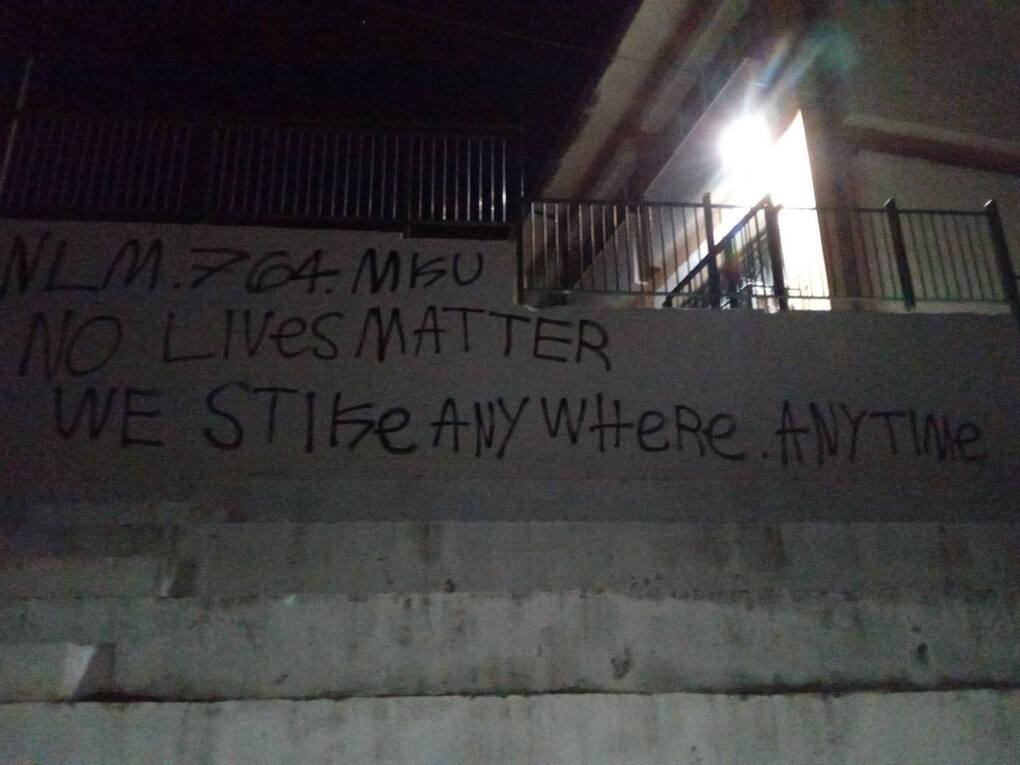
Example of NLM, 764 and MKU (Maniac Murder Cult) vandalism. (Source: Telegram)
The name No Lives Matter is an expression of the group’s violent nihilism and misanthropic worldview. It signals a rejection of the value of human life, turning social justice language into a banner for destruction. This name is not just provocative—it encapsulates NLM’s core belief: that life itself is meaningless, and violence is both a tool and a statement of that belief.
As part of its efforts to encourage targeted attacks, NLM has released multiple guides that provide step-by-step instructions for how to carry out acts of physical violence. For example, one guide provides instructions for constructing various improvised explosive devices and making poison. Others provide guidance on operational security practices and fighting techniques. Many of NLM’s guides borrow heavily from manifestos and instructional guides created by Maniac Murder Cult. In 2023, NLM partnered with Maniac Murder Cult on the “NLM Kill Guide,” which provides guidance on attack tactics and techniques. It concludes with the warning: “NLM x MKU we can strike anywhere, at any time.”
While No Lives Matter originated as an offshoot of 764, the group has attempted to distance itself from the network. In May 2024, NLM announced on Telegram that its alliance with 764 “had ended a while ago,” writing that “764 does live by our ideology they can still live by it if they want to, but NLM is its own groups [sic]…”
However, in August 2024, No Lives Matter announced on Telegram that it had reentered an alliance with 764 and that a new publication would be coming soon. The following month, in September 2024, a Telegram channel claiming affiliation with both 764 and NLM released a manifesto outlining the group’s beliefs and providing guidance on conducting attacks and grooming minors. The document announced NLM and 764 were reuniting “to bring terror to this mundane world.” Notably, the manifesto disavowed the groups’ previous involvement with child pornography, claiming that the sextortion was intended as a “troll,” and stating, “now we have no tolerance for that.” Instead, “NLM ideals and principles has [sic] taken over the wave.”
The manifesto was released the same day that a Swedish teenager, known online as Slain764, livestreamed himself stabbing an elderly man in Hässelby, Sweden. Slain764 is a prominent NLM member who claims to run the group’s Swedish cell, known as Mordwaffen ("mord” is the Swedish word for murder). He's also one of the individuals listed on the manifesto’s “roster,” a list of vetted members who can use NLM or 764 in their screennames.
Maniac Murder Cult
Maniac Murder Cult (also known as MKY, MKU and MMC) is a violent, neo-Nazi accelerationist group based in Russia and Ukraine. Founded by Ukrainian national Yegor Krasnov (also known as “Maniac”) around 2017-2018—prior to the emergence of 764—the group is known for its highly stylized propaganda videos and images of its members attacking homeless individuals. While MKY has claimed responsibility for more than 50 murders, their claims remain unverified.
Following Krasnov’s arrest by Ukrainian authorities in 2020, Georgian national Michail Chkhikvishvili, known as “Commander Butcher” online, emerged as MKY’s new leader. Chkhikvishvili has authored a series of instructional and ideological guides, including various editions of the “Haters Handbook,” which are frequently circulated in 764 and NLM spaces online. Notably, the third edition of the Haters Handbook, released in 2023, mentions alliances between MKY, No Lives Matter and two Satanic neo-Nazi accelerationist groups—Satanic Front (the newest iteration of Tempel ov Blood) and National Socialist Order of Nine Angles, or NSO9A—though there is little evidence of actual collaboration between these groups.
MKY and Commander Butcher’s violent propaganda have inspired multiple attacks around the globe.
- In January 2025, a 17-year-old boy opened fire inside Antioch High School in Nashville, Tennessee, killing one student and injuring another before taking his own life. According to the U.S. Department of Justice (DOJ), prior to his attack, the shooter posted an audio recording in which he claimed he was carrying out the shooting on behalf of MKY and at least one other group. The shooter also mentioned Chkhikvishvili and Krasnov by name in his manifesto and listed Krasnov among the names he planned to write on his guns, magazines and ammunition. He also shared photos of Krasnov in his diary, captioning them “I love this show,” as well as on Bluesky.
- In August 2024, an 18-year-old neo-Nazi livestreamed himself stabbing multiple people near a mosque in Eskişehir, Turkey. Along with his manifesto, he shared a copy of the Haters Handbook, publications from the Terrorgram Collective and the manifestos of the Christchurch, Buffalo and Bratislava shooters.
- In April 2022, a 17-year-old German national living in Romania livestreamed himself brutally stabbing and slitting the throat of an elderly woman, killing her. The teen reportedly committed the murder as part of his initiation into MKY and allegedly told authorities he targeted the woman because he believed she was of Roma or Jewish descent.
In July 2024, Chkhikvishvili was arrested in Moldova on U.S. charges related to soliciting hate crimes and acts of mass violence in New York City. According to the DOJ, Chkhikvishvili allegedly plotted to have one of his followers dress up as Santa Claus and hand out poisoned candy to Jewish children and members of other racial minorities on New Year’s Eve. Chkhikvishvili reportedly wanted the attack to be a “bigger action than Breivik,” referring to the Norwegian neo-Nazi who killed 77 people in a bombing and mass shooting in Norway in 2011. Chkhikvishvili was extradited to the United States in May 2025, where he is currently awaiting trial. Since Chkhikvishvili’s arrest, several copycat groups mimicking MKY’s aesthetics have emerged on Telegram.
Notable Arrests and Attacks
The FBI and DOJ classify 764 as a “Tier One/Category 1” terrorist threat, meaning it poses a direct threat to the national or economic security of the United States. In May 2025, the FBI revealed that it had opened more than 250 investigations into individuals affiliated with 764 and similar groups.
The 764 network has also been linked to recent school shootings in the United States. COE researchers have found that both the 15-year-old shooter who killed two people at Abundant Life Christian School in Madison, Wisconsin, in December 2024, and the 2025 Antioch school shooter engaged with 764-related content online.
Since 2021, at least 23 individuals affiliated with 764 and similar groups have been arrested globally for various crimes, including possession of child pornography, manufacturing and using explosive devices and operating a child exploitation enterprise, among other serious offenses. Some of these individuals include:
August 2021, Stephenville, Texas: 764 founder Bradley Cadenhead was arrested on child pornography charges after authorities traced an upload of CSAM on Discord to his mother’s apartment. According to authorities, Cadenhead manipulated children on Discord into self-producing explicit material and then blackmailed them into hurting themselves and animals on camera. Police also found child sex abuse material and images of children who had cut “I heart CP764” and “Brad is a pedo” into their bodies on Cadenhead’s laptop. Cadenhead described himself as a “cult leader” and was celebrated by his followers as a “god” for creating a “legendary group.”
On May 16, 2023, Cadenhead was sentenced to 80 years in prison for possession with intent to promote child pornography. During sentencing, the prosecutor reportedly told the judge, “Very rarely do we get a chance to look evil in the face. This may be one of those times.”
November 2021, Queens, New York: Three months after Cadenhead’s arrest, Angel Luis Almeida, an alleged member of 764, was taken into custody after an anonymous tip alerted authorities to graphic images depicting violence against children and animals on his social media accounts. Federal investigators reportedly became aware of 764 through their investigation into Almeida’s social media posts. During a search of his apartment, police reportedly found a handgun, books associated with the Order of Nine Angles and a flag bearing the insignia of Tempel ov Blood, among other items.
Almeida was initially charged with being a convicted felon in possession of a firearm but was later indicted on additional charges, including sexual exploitation of a minor, coercion and enticement of a minor, and possession of child pornography, among other alleged offenses. Prosecutors allege Almeida groomed a minor on Facebook and Instagram into producing sexually explicit videos of herself. He is also accused of convincing a girl to produce CSAM, allegedly holding her at gunpoint while she posed for a photo and coercing her to cut her neck so he could drink her blood. In May 2024, Almeida was found incompetent to stand trial. He is currently being held at a federal medical facility and could face up to life in prison if convicted.
April 2022, Dumbrăveni, Romania: Romanian authorities arrested a 764 member known online as “Tobbz” after he severely injured an 82-year-old man and fatally stabbed an elderly woman whom he suspected of having Roma or Jewish ancestry. Tobbz livestreamed the attack on the elderly woman on Discord and later uploaded the video to Telegram. Following the murder, he posted online: “I feel like God.”
After his arrest, police reportedly discovered child sex abuse material on his devices, along with content depicting beheadings and bombings. Tobbz reportedly joined several 764-affiliated groups online, including Maniac Murder Cult.
In August 2023, he was convicted of murdering the elderly woman and sentenced to 14 years in prison.
March 2024, United Kingdom: Counterterrorism police arrested Cameron Finnigan, a 764 member known as “ACID” online, after receiving reports that he possessed a firearm. While no weapon was found, investigators discovered online chats in which Finnigan encouraged an unidentified young woman to commit suicide on a livestream. According to police, Finnigan told the woman he wanted her to broadcast the act so he could record it and "claim it for ‘764.’" Police do not know what happened to the woman. In posts on Telegram, Finnigan told others he planned to kill a homeless man near his home for 764.
In January 2025, Finnigan was sentenced to six years in prison, followed by a three-year extended license period, after pleading guilty to encouraging suicide, possessing a terrorism manual and possessing indecent images of a child, among other offenses.
September 2024, Hässelby, Sweden: A 14-year-old boy known online as “Slain764”— who claimed to lead the Swedish cell of No Lives Matter, Mordwaffen—was arrested after stabbing two elderly individuals in a suburb of Stockholm. Both attacks were reportedly filmed and used to promote 764 on Telegram. According to Swedish state broadcaster SVT, at least six other attacks occurred in the same area, all of which were recorded and posted on Telegram.
The teen has reportedly confessed to both attacks. However, because he was under 15 years old at the time of the stabbings, he cannot be held criminally responsible under Swedish law. An administrative court has ordered that he be placed into care under Sweden’s Care of Young Persons (Special Provisions) Act.
February 2025, Bolzano, Italy: Police arrested a 15-year-old boy suspected of planning to murder a homeless man on livestream. Authorities say the teen is associated with 764; he faces multiple charges, including possession and distribution of child pornography and manufacturing and using explosive devices. Notably, he reportedly used “artificial intelligence search engines” to research the emotional states of terrorists during violent acts and how suicide bombers perceive pain during ‘martyrdom.’”
April 2025, Greece and North Carolina: The FBI arrested and charged Leonidas Varagiannis, known online as “War,” and Prasan Nepal, known as “Trippy,” alleged leaders of a 764 subgroup called 764 Inferno, for running a global online child exploitation enterprise. The FBI alleges Varagiannis and Nepal coerced at least eight underage victims, some of them as young as 13-years-old, to self-mutilate, produce child sex abuse material, sexually exploit siblings and harm animals, among other horrific acts. They could face up to life in prison if convicted.
Additional Resources
- National Center for Missing and Exploited Children (NCMEC): NCMEC is a non-profit organization dedicated to preventing the exploitation and victimization of children. It serves as a national clearinghouse for information and resources on these issues.
- CyberTipline: Operated by NCMEC, the CyberTipline is a centralized reporting system for reporting both online and offline child exploitation. Reports are reviewed and passed along to law enforcement agencies for investigation. Anyone can make a report 24/7.
- TakeItDown: TakeItDown is a free service operated by NCMEC that helps individuals remove explicit images or videos of themselves from the internet. It works by assigning a unique digital fingerprint (hash) to the content, which platforms can then use to detect and remove it from their services.
- Internet Crime Complaint Center (IC3): The FBI’s Internet Crime Complaint Center (IC3) allows individuals to report cybercrimes like extortion, hacking, and scams to the bureau.
- 988 Suicide & Crisis Lifeline: The 988 Lifeline offers free, confidential support for individuals in emotional distress or experiencing a mental health crisis. Call, text or chat 988 anytime to connect with trained counselors. Help is available 24/7.