










Related Content


By Jesse Tannetta
Director of Holocaust Content & Pedagogy, Echoes & Reflections
Echoes & Reflections has always believed that educators cannot properly teach the Holocaust without instructing on the history of antisemitism. As antisemitism began to rise again a decade ago, our commitment to teaching about antisemitism expanded to make it clear that antisemitism did not end after the Holocaust but continued to the present day. The Gringlas Unit on Contemporary Antisemitism, originally published in 2016, was revised in February 2020, just a few months after I had left the classroom and began working at Echoes & Reflections. It was a robust and successful lesson plan, with research published in early 2024 proving its effectiveness in educating students about contemporary antisemitism, increasing empathy, and empowering them to act. Even with its resounding success, there were plans to revise the unit in the fall of 2023.
Then October 7 happened.
The explosion of antisemitism that occurred in the aftermath was horrifying, but not surprising to those of us in the field. Antisemitism had been rising in the United States for nearly a decade, flowing from politicians, religious leaders, extremists, to conversations around family dinner tables, as well as proliferation on social media.
After a thoughtful pause and recalibration to the new realities of a post October 7 world, the plan for the new Gringlas Unit on Antisemitism after the Holocaust was to create a more evergreen resource that would trace how antisemitism morphs, transforms, and perverts itself to fit the fears of the day but always has salient points that repeat throughout history. The new title of the unit reflected how antisemitism was manifesting today. Antisemitism previously seen in the Arab and Soviet worlds after the Holocaust were being recycled and reshared, as evidenced by these cartoons that were revived and shared widely on social media in the aftermath of October 7.
The Gringlas Unit on Antisemitism after the Holocaust was published in October 2024. The Unit provides learning pathways for students to investigate the ways in which old ideas about Jews and Judaism have given rise to new expressions of antisemitism, and to empower them to recognize and act against this hate in its contemporary forms. The unit consists of four lesson plans: ∙Rebuilding Jewish Life after the Holocaust, What is Antisemitism and What are Features of Antisemitism?, What are Some of the Forces that Drive Antisemitism Today? And Action and Agency - Combating Antisemitism.
Lesson Two, the focus of a new study conducted by the ADL Center for Antisemitism Research, frames antisemitism as a cyclical phenomenon that functions as its own belief system, relying on conspiracy theories and antisemitic myths and tropes that place the Jew as the center of all that is evil in the world. This is one of the ways that makes antisemitism unique and according to this study, the lesson is quite effective in the classroom. After just one 45-minute class period, students were significantly less likely to endorse conspiratorial tropes about Jewish power, influence, and control.
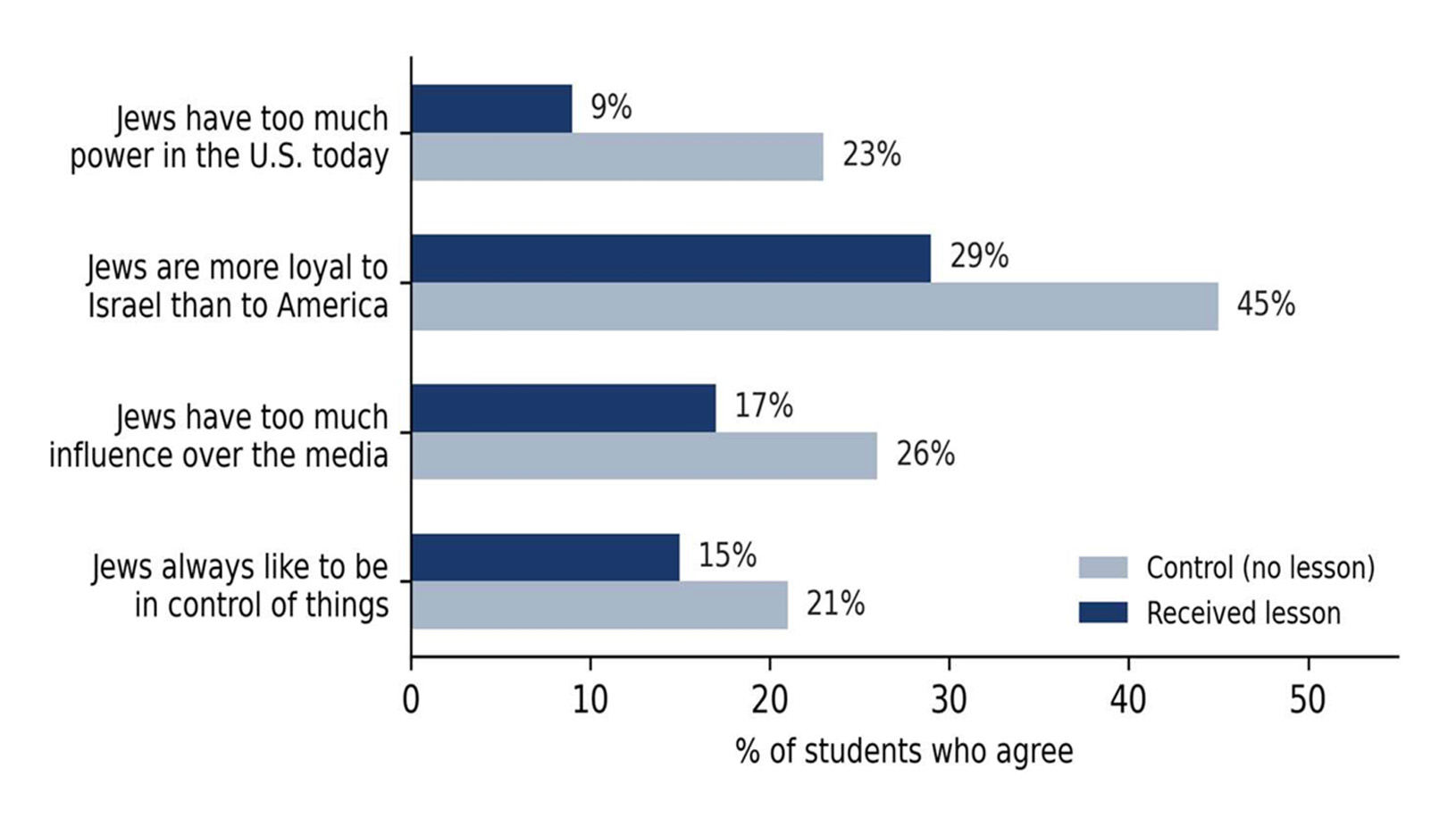
Antisemitism is embedded in our culture and is increasingly prevalent today. This research gives concrete evidence that educating students about the uniqueness of antisemitism as a cyclical conspiracy theory can equip them with the skills to recognize the tactics, dog whistles, and veiled terms that weaponize and promote this longest hatred. With this skill, our young people will be better equipped to recognize when they encounter antisemitic tropes intended to convince or manipulate them. They will be able to rely on their education, critical thinking, and civic efficacy to help transform our society into one that is free from the scourge of antisemitism.